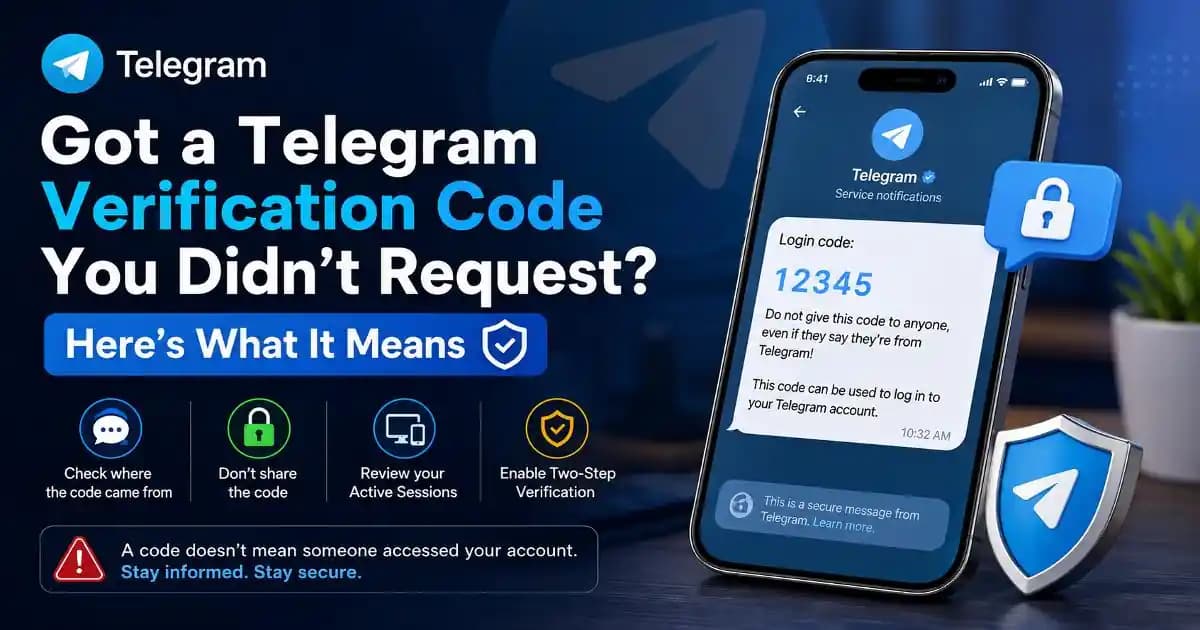



Fake verification codes are showing up in people's messages more often than ever, and for many users the experience begins with confusion. A code arrives unexpectedly. The phone vibrates. A notification appears. Yet the user was not logging in, resetting a password, or creating a new account.
For some people, the first reaction is panic. Others simply ignore the message and move on. Both reactions can be problematic because an unexpected verification code is often a signal that deserves attention, even if it does not mean an account has already been compromised.
As more services rely on phone-based authentication, verification messages have become part of everyday digital life. We see them when signing into social media accounts, banking apps, messaging platforms, delivery services, streaming subscriptions, and workplace tools. Because they are so common, many users no longer treat them as sensitive security events.
This shift in behavior is one reason verification-code scams continue growing during 2025 and 2026.
What Verification Codes Are and Why They Matter
Verification codes exist to prove that the person attempting to access an account controls a specific phone number or device.
They are often the final barrier between an attacker and an account. Even if someone knows a username, email address, or phone number, they may still need the verification code to complete the login process.
For years, these codes have helped improve account protection. Ironically, the same systems designed to increase security are now being exploited by scammers who understand how people react under pressure.
A useful way to think about a verification code is as a temporary digital key. The code itself may only remain valid for a short period, but during that window it can unlock significant access if shared with the wrong person.
Why People Are Receiving Unexpected Verification Codes
Not every unexpected verification code is part of a scam.
One of the most common explanations is a simple mistake. Someone enters the wrong phone number while attempting to log into an account. Because phone numbers often differ by only one digit, verification messages are frequently sent to unintended recipients.
Another possibility involves automated login attempts. Attackers increasingly use software to test large numbers of accounts across multiple services. These systems may trigger verification messages even though no successful login occurs.
Credential stuffing activity can also play a role. When attackers obtain lists of phone numbers from data breaches or publicly available sources, they sometimes test those numbers against popular platforms.
Many users assume an unexpected code automatically means a hack is already underway. In reality, the code often represents an attempted action rather than a successful compromise.
That distinction matters because it helps people respond rationally instead of emotionally.
How Scammers Use Verification Codes to Take Over Accounts
The most dangerous scams do not rely on technical sophistication. They rely on human behavior.
A common pattern begins when a scammer intentionally triggers a legitimate verification code. Shortly afterward, they contact the target through a call, text message, social media account, marketplace conversation, or messaging app.
The story varies, but the objective remains the same.
Some claim the code was sent accidentally. Others pretend to be customer support representatives. Some impersonate friends, colleagues, employers, or business contacts.
The scam succeeds when the victim shares the code.
One interesting behavioral pattern has emerged in recent years. Users are becoming more skeptical of links but remain surprisingly trusting when asked to share codes directly. Many people understand phishing links are dangerous, yet they underestimate the importance of authentication codes.
Scammers exploit this gap in awareness.
Another factor is urgency. When people feel rushed, they often focus on solving the immediate problem rather than evaluating the situation. Fraudsters intentionally create pressure because rushed decisions reduce critical thinking.
Common Platforms Targeted by Verification Code Scams
Verification-code scams appear across nearly every major digital platform.
Messaging services such as WhatsApp, Telegram, Signal, and Messenger remain frequent targets because compromised accounts provide direct access to trusted relationships.
Social media platforms including Instagram, Facebook, TikTok, and X are also heavily targeted. Attackers understand that control of a social account can be used to impersonate users, distribute scams, or collect additional information.
Banking apps, payment platforms, and digital wallets receive significant attention because financial accounts can generate direct monetary rewards.
Even workplace tools and cloud services have become attractive targets as remote work remains common.
The growing number of connected accounts means that a single verification code may sometimes protect access to much more than one application.
What to Do If You Receive an Unrequested Code
The first step is simple: do not share the code.
Even if the request appears reasonable, urgent, or helpful, verification codes should remain private.
Next, consider the context. Was the code connected to a recent login attempt? Did someone contact you shortly afterward? Are there signs of unusual activity on the account?
If the platform provides active-session information, review it. Many services allow users to see devices currently connected to their accounts.
Changing passwords, enabling multi-factor authentication, and reviewing account recovery settings can also provide additional protection.
The goal is not to panic. The goal is to verify.
One of the healthiest digital habits in 2026 is learning to pause before reacting to unexpected account notifications.
How to Secure Your Accounts Against Verification Fraud
Protection starts with understanding that verification codes are valuable information.
Enable multi-factor authentication whenever possible. Use strong passwords that are not reused across services. Review account activity periodically. Remove old devices that no longer need access.
Just as importantly, develop awareness of social engineering tactics.
Most verification-code scams do not begin with malware. They begin with conversation. Someone asks for help, claims there is an emergency, creates urgency, or presents a believable story.
Understanding these psychological triggers is often more effective than relying solely on technical tools.
The reason fake verification codes seem to be everywhere right now is not because verification systems are failing. It is because scammers have learned that trust, familiarity, and routine behavior can be easier to exploit than software vulnerabilities.
Recognizing that reality helps users make better decisions when the next unexpected code appears on their screen.