


Online scam mistakes often begin long before a scam Message actually appears. A person taps a notification without reading carefully, reuses an old password because it feels convenient, or trusts a familiar-looking login screen automatically while distracted on a phone.
None of these actions feel dangerous in the moment.
That is exactly why modern scams increasingly succeed through ordinary behavior instead of dramatic hacking techniques.
During 2025 and 2026, cybercriminals have become far more focused on how people behave online than on breaking technical systems directly. The internet itself has become faster, more automated, and more emotionally reactive. Users move quickly between apps, approve notifications automatically, multitask constantly, and make trust decisions within seconds.
Attackers understand these habits extremely well.
Many scams no longer rely on obvious malware or suspicious-looking websites. Instead, they blend into normal digital routines so smoothly that users often cooperate without realizing they are being manipulated.
This shift has changed online safety completely. The biggest vulnerabilities today are often small behavioral patterns that feel harmless individually but become risky when repeated daily.
Speed Quietly Reduced Digital Attention
Modern internet behavior rewards fast reactions.
People answer messages while walking, approve app prompts during conversations, and respond to emails between tasks at work. Mobile phones intensified this behavior because everything now happens through quick taps and compressed attention spans.
Scammers adapted to this environment.
A fake delivery message only needs a few seconds of trust. A phishing page succeeds when someone reacts emotionally before checking details carefully. A fake verification request becomes effective when users are already conditioned to approve notifications automatically.
These attacks work because many people no longer pause before responding.
One of the most common online scam mistakes today is assuming that familiarity equals safety. Users trust logos, layouts, message styles, and notification designs because they resemble platforms already used every day.
But modern scams imitate familiarity intentionally.
Some phishing campaigns now copy customer support systems, payment confirmations, cloud storage alerts, banking messages, streaming notifications, and workplace collaboration tools with remarkable realism.
The result is a digital environment where trust often activates before critical thinking does.
Reusing Passwords Still Creates Huge Problems
Password reuse remains one of the simplest behaviors scammers exploit repeatedly.
Many users continue recycling the same passwords across multiple platforms because remembering unique credentials feels exhausting. Unfortunately, this creates chain-reaction risks after data breaches.
If one smaller service becomes compromised, attackers often test stolen credentials across email accounts, shopping platforms, banking systems, streaming subscriptions, and social media profiles automatically.
This process, sometimes called credential stuffing, succeeds largely because people underestimate how interconnected their accounts actually are.
The emotional logic behind password reuse is understandable. Convenience feels immediate, while risk feels abstract and distant.
However, once attackers access a primary email account, they often gain access to password resets, account recovery systems, verification systems, and identity protection controls connected to many other services.
What begins as a “small shortcut” can therefore expand into a much larger security problem very quickly.
People Often Trust Urgency More Than Logic
Many scams succeed because emotional pressure changes how users evaluate situations.
A message warning about suspicious account activity, failed payments, locked subscriptions, or urgent verification requests creates psychological momentum. The brain shifts toward solving the problem immediately instead of evaluating whether the message itself is legitimate.
This reaction is deeply human.
Scammers know that anxious users click faster, inspect less, and question fewer details.
That is why phishing protection today depends heavily on emotional awareness rather than technical expertise alone. Some users imagine scams only target inexperienced people, but even highly educated users react differently under stress, distraction, or urgency.
Modern social engineering attacks are carefully designed around those emotional patterns.
Many fake login pages now appear after realistic scenarios such as shared documents, package tracking alerts, workplace messages, security notifications, or payment confirmations.
Because the situation feels believable, users lower their guard naturally.
Mobile Habits Changed Scam Behavior
Phones transformed digital decision-making.
On desktops, users could often inspect browser details more carefully. Mobile devices reduced visible context dramatically. URLs are harder to read, browser bars collapse while scrolling, and notifications interrupt attention constantly.
This environment favors fast emotional reactions.
Many users also allow apps broad permissions without reviewing them carefully. Certain malicious apps abuse notification access, accessibility settings, SMS permissions, or overlay systems in ways that support larger scam campaigns later.
App permission abuse increasingly overlaps with phishing attacks because scammers understand how much trust users place in familiar phone behavior.
Some fake authentication prompts now imitate operating system alerts themselves. Others mimic bank verification screens or messaging app login requests so convincingly that users respond automatically.
The danger is not always technical complexity. Often, the danger comes from how routine these interactions feel.
People Ignore Small Warning Signs Repeatedly
Another major online scam mistake is assuming obvious danger will always look dramatic.
In reality, scams often depend on tiny inconsistencies users dismiss quickly.
A slightly unusual domain name. A verification request arriving unexpectedly. A support message creating unnecessary urgency. A login screen that feels “slightly off” but still believable enough to continue.
Many users notice these details subconsciously but continue anyway because nothing immediately appears catastrophic.
This behavioral pattern matters more than many realize.
Modern phishing campaigns frequently rely on partial skepticism rather than complete trust. Attackers only need users to ignore doubts briefly long enough to enter credentials, approve notifications, or share authentication codes.
The internet today is filled with interfaces specifically designed to reduce hesitation. That design culture affects scam behavior too.
Fast buttons, simplified approvals, endless notifications, and automatic workflows train people to continue quickly instead of stopping to evaluate.
Verification Fatigue Became a Real Security Problem
Users now receive endless authentication prompts, login approvals, account alerts, cookie banners, security notifications, and permission requests.
Over time, many people stop reading carefully altogether.
This creates what cybersecurity researchers increasingly describe as verification fatigue.
When every service constantly asks users to confirm actions, people gradually respond automatically without evaluating each request independently.
Scammers exploit this exhaustion directly.
A fake approval request feels less suspicious inside a digital environment already overloaded with alerts. Many users simply assume the request belongs to something legitimate because they are accustomed to constant interruptions.
This is one reason digital literacy has become more behavior-focused during recent years. The challenge is no longer just understanding technology. It is understanding how technology shapes attention, trust, and decision-making.
Safer Habits Usually Sound Surprisingly Simple
The strongest protections are often behavioral rather than technical.
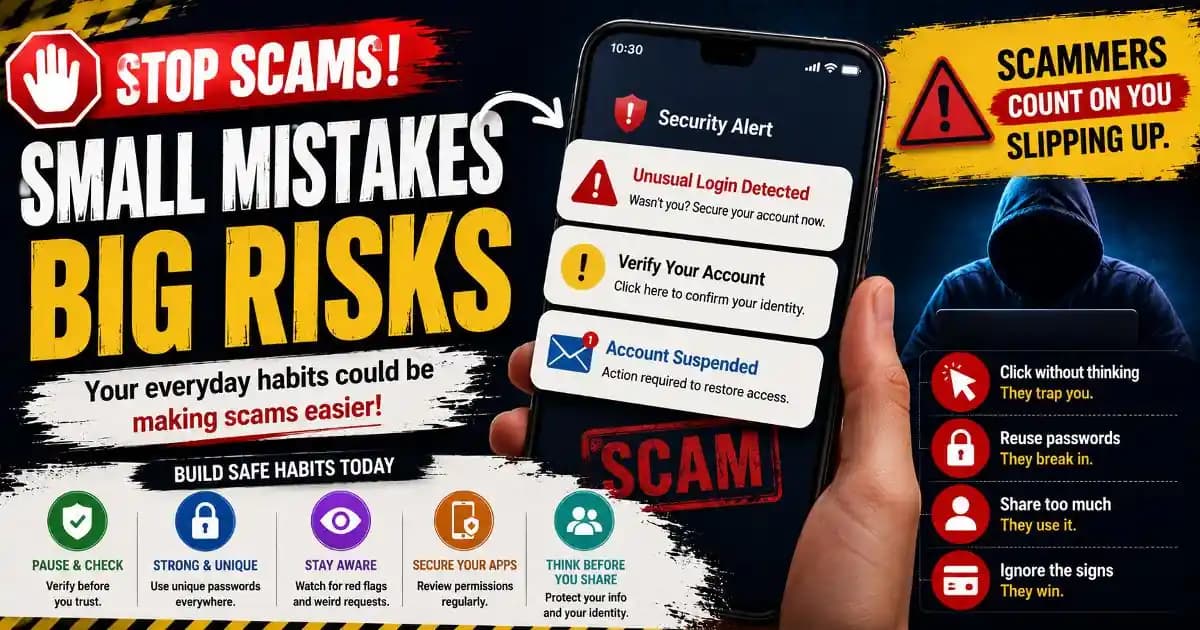
Opening official apps directly instead of clicking links. Using password managers. Pausing before responding to urgent messages. Reviewing app permissions occasionally. Separating emotional reactions from account decisions.
These habits sound small because they are small.
But modern scams often depend on users staying emotionally automatic and behaviorally rushed.
The safest internet users are usually not the people who understand every technical detail. They are the people who slow down long enough to recognize when something feels designed to manipulate their attention or emotions.
That awareness matters increasingly in an online environment where scams no longer look obviously malicious.
Many of the biggest online scam mistakes today are not caused by ignorance. They are caused by ordinary human behavior operating inside systems specifically optimized for speed, convenience, and constant reaction.
Frequently Asked Questions
What are the most common online scam mistakes today?
Rushed clicks, password reuse, ignoring small warning signs, and trusting urgent messages too quickly are among the most common mistakes.
Why do scams work even on experienced users?
Stress, distraction, emotional urgency, and routine online behavior affect nearly everyone at times.
How do phones increase scam risks?
Smaller screens, fast notifications, hidden URLs, and automatic behavior make careful verification less likely.
What is verification fatigue?
It is the habit of approving endless notifications and prompts automatically without reading them carefully.
How can users reduce online scam risks?
Pause before reacting, verify requests independently, use strong passwords, and avoid trusting urgent messages automatically.