


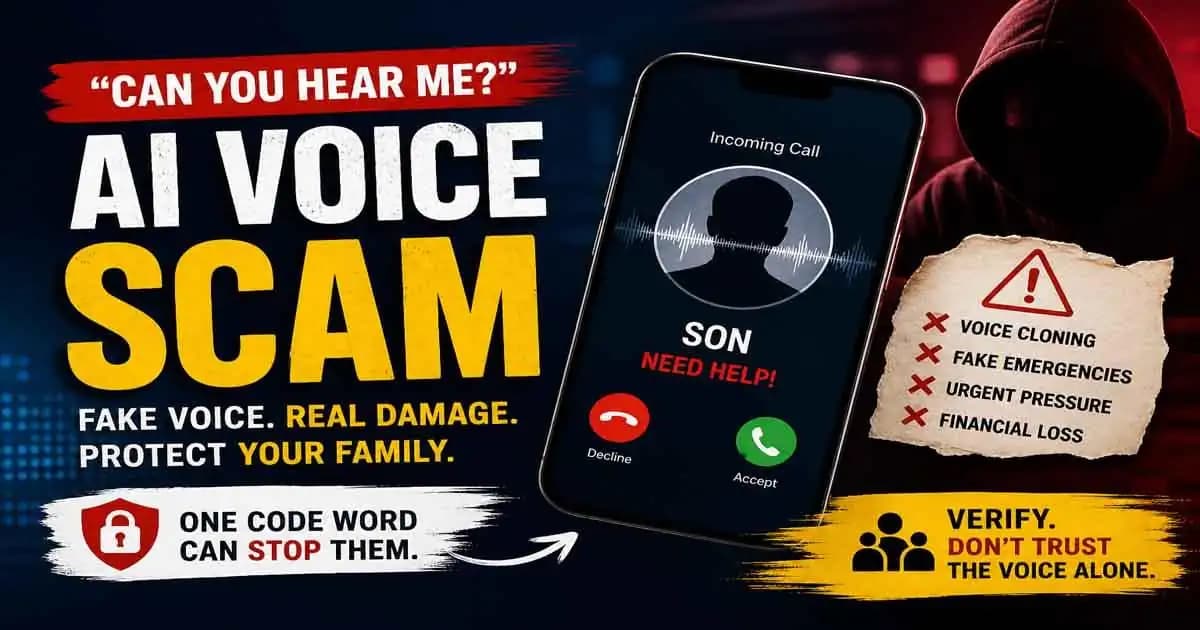
Did you notice the Can You Hear Me AI Voice Scam? It usually starts with a call that feels just a little off but not enough to hang up.
“Can you hear me?”
The voice sounds familiar. Maybe it’s your son, your sister, or even a close friend. There’s urgency, maybe even panic. They say they’re in trouble an accident, a legal issue, something that needs money right now.
And before you have time to think clearly, you’re already reacting.
This is the “Can You Hear Me?” AI voice scam, and it’s becoming one of the most unsettling forms of fraud today not because of technology alone, but because it targets something deeply human: trust.
How a 3-Second Video Becomes a Fake Voice
Most people assume Voice Cloning is complicated. It used to be.
Now, it’s not.
Scammers can take a short audio clip sometimes just a few seconds from Instagram, TikTok, or even a WhatsApp voice note, and feed it into AI tools that recreate a person’s voice with surprising accuracy.
Think about how often people post:
- A quick birthday wish video
- A casual Instagram story
- A short voice message in a group chat
That’s all it takes.
The result isn’t perfect but it doesn’t need to be. In a stressful moment, your brain fills in the gaps. If it sounds close enough, and the situation feels urgent, most people don’t question it.
Why the “Emergency” Story Works So Well
There’s a pattern in these scams, and once you notice it, it becomes easier to spot.
The call is almost always about an emergency:
- “I’ve been in an accident.”
- “I’m stuck and need money urgently.”
- “Don’t tell anyone, just help me right now.”
The goal is simple: create pressure so you don’t pause and verify.
When people feel urgency, their thinking shifts. Instead of analyzing, they act. Especially when the voice sounds like someone they care about.
Scammers know this. They rely on it.
Why We Trust Voices More Than Messages
If you received the same request as a text, you might hesitate.
But hearing a voice changes everything.
Humans are wired to trust voices. Tone, emotion, and familiarity create a sense of authenticity that text simply can’t match.
Even if something feels slightly off maybe the tone is unusual, or the phrasing is strange your brain often overrides doubt with recognition.
That’s why this scam works so well.
It’s not just technology. It’s psychology.
A Simple Habit That Changes Everything: The Family Code Word
One of the most effective ways to protect yourself doesn’t involve any app or tool.
It’s a simple agreement within your family: a shared emergency code word.
This is a word or phrase that only your inner circle knows something you would use in a real emergency.
For example:
If someone calls claiming to be your child in trouble, you can calmly ask:
“Tell me the code word.”
A scammer won’t have it.
Even if the voice sounds real, the conversation stops right there.
This works because it shifts the situation from emotional reaction to Verification something scammers can’t easily bypass.
What to Pay Attention to During a Suspicious Call
You don’t need to become paranoid but a small shift in awareness can make a big difference.
Sometimes it’s not about what is said, but how it’s said.
- The caller avoids answering direct questions
- They push you to act immediately
- They discourage you from contacting others
- Details feel vague or inconsistent
Even small hesitations matter.
If something feels rushed or emotionally overwhelming, that’s often the signal to slow down not speed up.
What to Do in the Moment (Without Escalating Panic)
If you ever receive a call like this, the goal is not to confront but to create space to think.
You can respond calmly:
“Okay, I’m going to call you back.”
Then hang up and contact the person directly using their real number.
Or reach out to someone else who can confirm their situation.
Even a short pause can break the scammer’s momentum.
If You Already Responded or Sent Money
This happens more often than people admit. The emotional pressure can be overwhelming.
If you realize afterward that it may have been a scam:
- Contact your bank or payment provider immediately
- Report the incident to local cybercrime authorities
- Inform your family so they stay alert
Time matters here. Acting quickly can sometimes limit the damage.
More importantly, don’t stay silent out of embarrassment. These scams are designed to manipulate not because you weren’t careful, but because you’re human.
A Preventive Mindset That Actually Works
Technology will keep improving. Voice cloning will become even more convincing.
So protection isn’t about avoiding technology it’s about changing how we respond.
A few small shifts can go a long way:
- Don’t rely on voice alone as proof of identity
- Normalize verifying unusual requests even with family
- Be cautious about sharing clear voice clips publicly
- Talk openly with your family about these scams
The goal isn’t fear. It’s awareness.
Why This Scam Is Growing So Fast
What makes this trend different is how easily it scales.
Scammers don’t need deep technical skills anymore. Many tools are widely available, and social media provides endless audio samples.
At the same time, people are more connected and more emotionally responsive than ever.
That combination creates the perfect environment for this type of fraud.
A Small Conversation That Can Protect Your Family
If there’s one practical step that makes a real difference, it’s this:
Have a simple conversation with your family.
Not a long lecture just a shared understanding:
“If any of us is ever in trouble, we’ll use this code word.”
That one agreement can stop a scam in seconds.
FAQ
1. How accurate are AI voice clones really?
They don’t need to be perfect. Even a close imitation can feel real in an emotional situation, especially over a phone call.
2. Can scammers get my voice without me knowing?
Yes. Public videos, voice notes, and even short clips from social media can be enough.
3. Is this scam common worldwide?
Yes, it’s spreading globally as AI tools become more accessible.
4. What’s the safest way to verify a call like this?
Hang up and call the person directly using a trusted number, or ask for a pre-agreed code word.
5. Should I stop posting videos online?
Not necessarily but being mindful of what you share and who can access it is a smart precaution.