


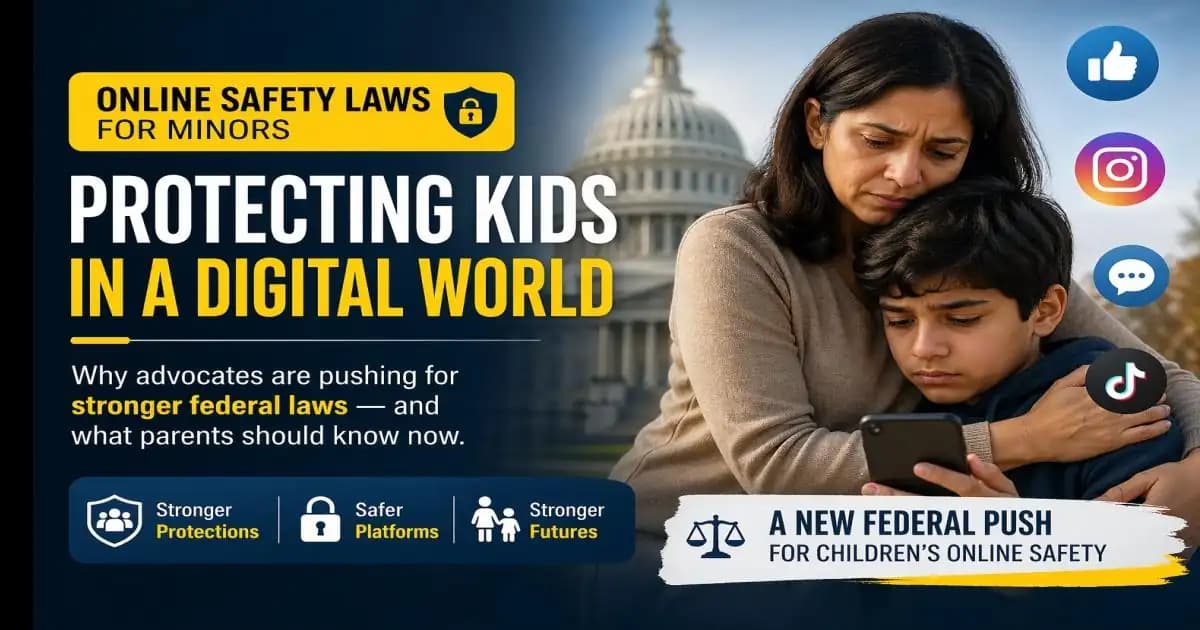
online safety laws for minors didn’t mean much to Priya until the afternoon her 13-year-old son Aarav came home unusually quiet.
It wasn’t obvious at first. No broken phone, no visible panic. Just a silence that didn’t belong to a child who usually narrated his entire day the moment he walked through the door.
That night, while scrolling through her own phone, Priya noticed Aarav sitting beside her, staring at the same Instagram reel over and over again. Not laughing. Not reacting. Just… watching.
“Something wrong?” she asked casually.
He shook his head too quickly.
That was the moment she knew something was off.
A conversation that almost didn’t happen
It took two days before Aarav finally said anything.
It came out in fragments. Not as a confession, but as hesitation.
A “friend” he met through a gaming community had asked him to join a private group chat on another app. At first, it felt normal just memes, jokes, and game tips. Then the tone shifted.
Someone shared a “challenge.”
It wasn’t Dangerous in an obvious way. No threats, no violence. Just dares post something embarrassing, send a selfie doing something weird, keep it going or you’re “out.”
Aarav laughed it off at first. But when he hesitated, the messages changed.
“You think you're better than us?”
“Don’t be boring.”
“Everyone else is doing it.”
Then came the screenshots.
Private messages he’d sent earlier nothing serious, just typical teenage chatter suddenly felt like leverage. Someone hinted they could be shared publicly.
It wasn’t blackmail in the traditional sense. It was social pressure, amplified by the architecture of the platform.
Aarav didn’t call it bullying. He didn’t call it a scam. He just said, “I didn’t know how to leave.”
What parents often miss
Priya did what most parents do she looked for something concrete.
Was there a predator? A fake profile? A known scam pattern?
But what she found was more complicated.
The accounts looked real. The conversations felt organic. There was no single “bad actor.” Just a group dynamic that escalated in ways no one fully controlled or maybe everyone did.
This is where conversations about online safety laws for minors begin to feel real.
Because the risk isn’t always a stranger hiding behind a fake name.
Sometimes it’s systems designed to keep kids engaged, connected, and visible without fully understanding the consequences.
What’s happening beyond one household
At the same time Priya was trying to understand Aarav’s situation, a very different conversation was unfolding thousands of miles away.
Advocacy groups, parents, and policymakers were gathering in Washington, pushing for stricter federal regulations on social media platforms.
Not because of one case but because of patterns.
Court cases had started to reveal something uncomfortable: platforms often knew how their features affected younger users, especially around:
- Endless content loops
- Algorithm-driven exposure
- Social validation systems (likes, comments, shares)
- Private messaging without friction
These weren’t accidental features. They were designed for engagement.
And when used by minors, they sometimes created environments where pressure, comparison, and manipulation could grow quietly.
Where things go wrong (and why it’s not obvious)
Looking back, Priya kept asking herself the same question:
“Why didn’t I see this earlier?”
But the truth is, there wasn’t a clear moment to catch.
No warning notification saying “your child is at risk.”
No dramatic shift that triggered immediate alarm.
Instead, it was gradual:
- A new app download
- A few new online friends
- Slight changes in mood
- Increased screen time
Individually, none of these felt alarming.
Together, they told a story.
The invisible pressure of “normal”
What Aarav experienced isn’t rare.
Many kids don’t recognize manipulation because it doesn’t feel like danger.
It feels like belonging.
The fear isn’t physical harm it’s exclusion.
Being removed from a group. Being labeled “boring.” Being left out of conversations that continue without you.
Platforms unintentionally amplify this.
Features like read receipts, typing indicators, and instant sharing create an environment where silence becomes noticeable and sometimes punishable socially.
For adults, these are conveniences.
For kids, they can become pressure points.
Why laws are being pushed now
The growing push for online safety laws for minors isn’t about banning social media.
It’s about acknowledging that digital environments shape behavior especially for users who are still developing emotionally and socially.
Some of the proposed changes being discussed include:
- Age-appropriate design standards
- Restrictions on certain engagement-driven features for minors
- Stronger privacy defaults
- Transparency around algorithms
- Easier reporting and intervention tools
But even as these discussions move forward, one thing remains clear:
Laws can set boundaries, but they can’t replace awareness at home.
What Priya did next
Priya didn’t take Aarav’s phone away.
She didn’t delete his accounts overnight.
Instead, she sat with him and went through the messages together.
Not to interrogate but to understand.
They talked about:
- How group dynamics work online
- Why people push boundaries in digital spaces
- What control actually looks like (muting, blocking, leaving)
- The difference between friendship and pressure
For the first time, Aarav saw the situation differently.
Not as something he “failed” to handle but as something designed to be hard to navigate.
What this story quietly teaches
Most online risks don’t start as obvious threats.
They start as small interactions that slowly shift in tone.
A message. A group. A joke that goes too far.
By the time it feels uncomfortable, leaving doesn’t feel easy anymore.
That’s the gap both parents and policymakers are trying to close.
A more grounded way to think about protection
Protecting kids online isn’t just about monitoring apps or setting time limits.
It’s about helping them recognize situations where they feel:
- Pressured instead of comfortable
- Watched instead of connected
- Obligated instead of interested
And giving them permission to step away without guilt.
Because sometimes the safest choice doesn’t feel like the easiest one.
FAQ
1. Are social media platforms dangerous for kids?
Not inherently, but certain features can create pressure or exposure risks if not designed with minors in mind.
2. What are online safety laws for minors trying to change?
They aim to regulate platform design, improve Privacy, and reduce harmful engagement patterns affecting young users.
3. How can parents tell if something is wrong?
Look for subtle behavior changes withdrawal, anxiety, or reluctance to talk about online interactions.
4. Should kids be banned from social media entirely?
Not necessarily. Guided use and open communication are often more effective than strict bans.
5. What’s the most important step parents can take?
Create an environment where kids feel safe talking about uncomfortable online experiences without fear of punishment.