


online gaming safety for kids started to feel like more than just a general concern the night Daniel overheard his 11-year-old son arguing loudly through his headset.
At first, it sounded like any other gaming session fast talking, a bit of frustration, bursts of laughter. But then the tone shifted.
“Just tell me where you’re from,” a voice pushed.
“No, I don’t want to,” his son replied.
“Relax, everyone shares here.”
Daniel paused in the hallway. He wasn’t even sure which game it was Roblox, Fortnite, Minecraft everything blended together these days. But what caught his attention wasn’t the game.
It was the pressure.
What changed in gaming and why this moment matters now
For years, online (1) gaming has quietly transformed from a solo activity into a fully social environment.
Kids aren’t just playing anymore. They’re:
- Chatting in real time
- Joining private servers
- Building friendships with strangers
- Sharing voice, text, and sometimes personal details
And in 2026, this shift is exactly why regulators are paying attention.
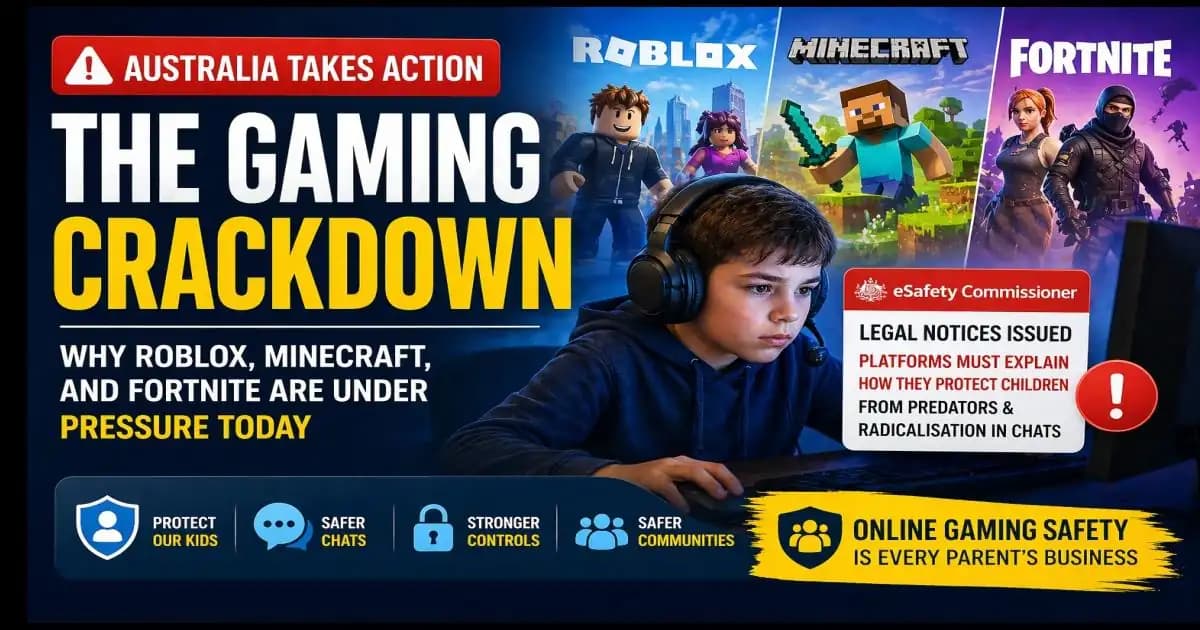
Today, Australia’s eSafety Commissioner formally issued legal notices to major gaming platforms asking a direct question:
What are you actually doing to protect children inside these live environments?
Not in theory. Not in policy pages.
But in real time.
What parents think is happening vs what actually is
Most parents, like Daniel, assume a simple model:
“My child is playing a game.”
But what’s really happening looks closer to this:
Your child is inside a live, open network of strangers, interacting through:
- Voice chat channels
- Private messages
- In-game social systems
- User-generated content
The game itself is only one layer.
The social layer is where most of the risk and influence exists.
And that layer is constantly active, often without friction.
How interactions quietly evolve
In Daniel’s case, his son wasn’t talking to someone he just met.
It started days earlier.
A friendly teammate during a match. Someone helpful. Someone who stayed after the game.
Then came:
“Add me.”
“Join our group.”
“We play every night.”
Nothing alarming. In fact, it looked like friendship.
But over time, the tone changed.
Questions became more personal.
Requests became more specific.
And slowly, boundaries started to blur.
Why platforms are under pressure now
The current push from regulators isn’t random it’s built on growing evidence.
Investigations and court discussions have revealed that:
- Predators often use games as entry points
- Radical communities recruit through casual chat spaces
- Moderation systems struggle with real-time voice communication
- Reporting tools are often too slow or unclear for kids
Platforms like Roblox, Minecraft, and Fortnite aren’t being accused of creating harm.
They’re being asked to explain how they prevent harm from happening inside their ecosystems.
Because unlike traditional social media, gaming interactions are:
- Faster
- More immersive
- Less visible to parents
The invisible advantage of “normal behavior”
What makes gaming environments especially complex is that nothing feels out of place.
Talking to strangers? Normal.
Joining groups? Normal.
Following someone into a private server? Also normal.
That’s the challenge.
Harmful interactions don’t start as obvious threats.
They blend into expected behavior.
Which is why kids rarely recognize when something is crossing a line.
How manipulation actually works in these spaces
In many cases, there isn’t a dramatic moment.
No sudden danger.
Instead, it’s gradual.
A player builds trust over time. Shares small personal details. Asks harmless questions.
Then slightly more personal ones.
“Which country are you in?”
“What time do you usually play?”
“Do your parents check your game?”
None of these questions seem dangerous on their own.
But together, they build a profile.
And once familiarity is established, influence becomes easier.
Why 2026 feels like a turning point
The conversation around online gaming safety for kids has been growing for years.
But what’s different now is accountability.
Governments are no longer just issuing guidelines they’re demanding transparency.
The Australian action signals something broader:
A shift from “trust platforms to manage safety” to
“prove how safety is actually enforced.”
This includes:
- Real-time moderation capabilities
- Detection of harmful patterns, not just keywords
- Age-aware protections
- Faster intervention systems
Because the scale of these platforms makes manual control impossible.
What Daniel did differently after that night
Daniel didn’t ban the game.
He didn’t take the headset away.
Instead, he sat down and asked a simple question:
“Do you know who you’re playing with?”
At first, his son shrugged. “Just people.”
That answer said everything.
They started going through the friend list together.
Some names were familiar. Some weren’t.
Some conversations made sense. Others felt… off.
Daniel didn’t lecture.
He explained what he was seeing:
“How someone can act friendly and still have bad intentions.”
“How sharing small details adds up.”
“How leaving a game is always okay even if it feels awkward.”
For the first time, his son started noticing patterns he hadn’t before.
Why awareness matters more than restriction
The instinct to restrict is understandable.
But in reality, most kids will continue to use these platforms increasingly so.
What matters more is recognition.
Understanding:
- When a conversation feels different
- When curiosity becomes pressure
- When someone is asking for more than they should
Because the biggest risk isn’t exposure.
It’s confusion.
Not knowing when something is no longer safe.
A clearer way to think about gaming safety
Online games today are not just entertainment spaces.
They are live social ecosystems.
And like any social space, they include:
- Positive connections
- Neutral interactions
- And occasionally, harmful behavior
The difference is speed and scale.
Which is why both regulation and awareness are catching up now.
Where this is heading next
The current global scrutiny suggests something important:
Safety in gaming is no longer a secondary feature.
It’s becoming a core expectation.
Platforms will likely be pushed to redesign:
- How players connect
- How conversations are monitored
- How quickly risks are detected
But even with better systems, one thing won’t change:
Kids will still be navigating these spaces in real time.
And understanding what’s happening will always be their first layer of Protection.
FAQ
1. Are games like Roblox and Fortnite unsafe for kids?
Not inherently, but their social features can expose kids to interactions that require guidance and awareness.
2. What is Australia asking gaming platforms to do?
They are demanding transparency on how platforms detect and prevent harm in real-time chats.
3. Can parents monitor gaming chats easily?
Not always, especially with voice chat and private servers, which makes awareness more important.
4. What should kids avoid sharing in games?
Personal details like location, schedules, or family information.
5. Is banning games the best solution?
Usually not. Teaching awareness and safe interaction is more effective long-term.