


Public WiFi risks often begin with something that looks completely harmless: a login screen asking users to connect before accessing the internet.
A traveler arrives at an airport, opens a phone, and taps the network with the strongest signal. A café customer sees a page asking for an email address before continuing. A hotel guest accepts terms on a polished login screen that looks professionally branded and familiar.
Most people treat these moments as routine.
That sense of routine is exactly why public Wi-Fi environments have become increasingly attractive for scammers and cybercriminals during 2025 and 2026.
Public internet access is designed to feel simple and convenient. Users expect quick access, minimal friction, and fast connectivity. Under those conditions, many people stop verifying details carefully because the goal is speed, not caution.
Attackers understand this behavior extremely well.
Why Login Screens Create Automatic Trust
Most users associate structured login pages with legitimacy.
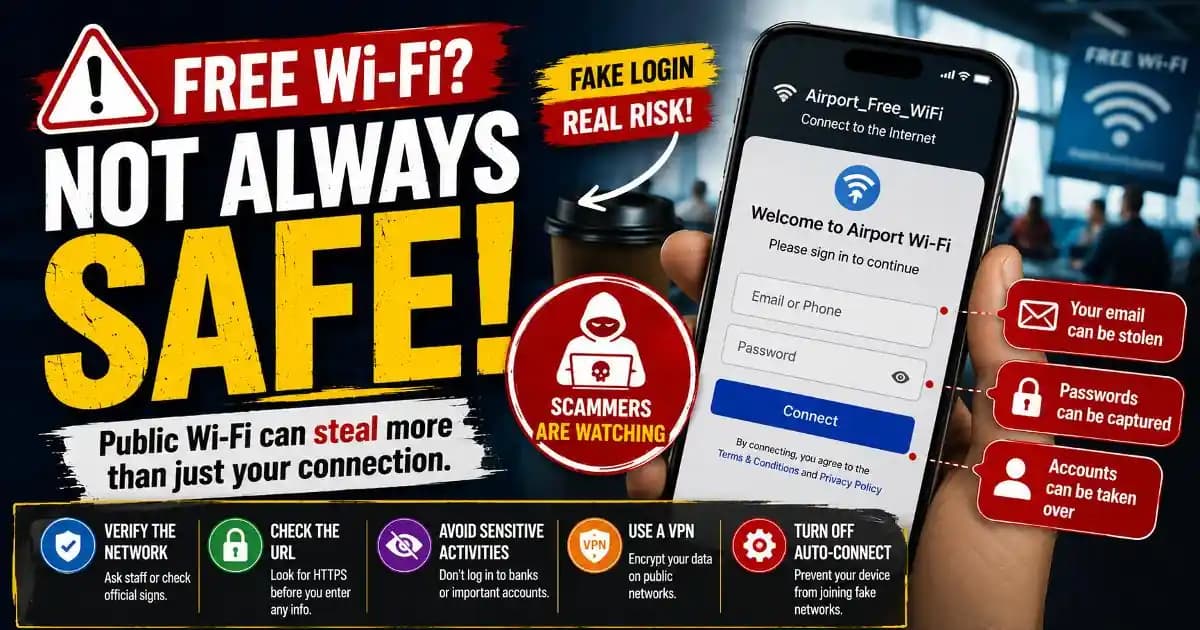
When a public Wi-Fi portal displays a hotel logo, café branding, airport name, or terms-of-service page, the brain naturally assumes the network is official. The design itself creates psychological reassurance.
That trust becomes stronger on mobile devices where users interact quickly and rarely inspect technical details closely.
Some fake Wi-Fi portals imitate legitimate networks closely enough that users never realize they connected to the wrong system. A fraudulent hotspot may even use a name almost identical to the real network, differing by only a single character or extra word.
Once connected, attackers can present fake login screens designed to collect email addresses, passwords, authentication codes, or other personal information.
In many cases, the internet connection still works afterward, making the interaction feel completely normal.
This is one reason phishing protection now extends far beyond email scams alone.
Why Public Wi-Fi Environments Attract Attackers
Public networks create ideal conditions for social engineering and deceptive behavior.
People connect while distracted, tired, traveling, rushing between locations, or multitasking in crowded environments. Airports, shopping centers, hotels, conferences, cafés, and transportation hubs naturally reduce careful attention.
Users also assume that if many people are connected to the same network, the environment must be safe.
Attackers take advantage of this social assumption.
Some create rogue hotspots that imitate trusted public networks. Others intercept unencrypted traffic or attempt session hijacking attacks against insecure websites and poorly protected connections.
More advanced scams may combine fake Wi-Fi login portals with malicious browser notifications, deceptive app downloads, or fraudulent account verification requests.
The danger is often not the Wi-Fi signal itself, but the false sense of legitimacy surrounding the connection process.
How Mobile Habits Increase the Risk
Phones changed how people interact with public networks.
Many users now connect automatically without reviewing network names carefully. Some devices remember previously joined hotspots and reconnect silently later. Others prioritize convenience features that reduce friction but also reduce awareness.
On smaller screens, browser details become harder to inspect. Login portals appear quickly, notification prompts interrupt attention, and users focus on reaching the internet instead of evaluating security indicators.
This environment encourages fast reactions.
Some public Wi-Fi scams now mimic mobile operating system prompts directly. Others imitate account verification systems from Google, Apple, Microsoft, or streaming services to make login requests appear familiar.
At the same time, app permission abuse has become increasingly connected to public network scams. Users rushing through connection steps may approve unnecessary permissions or install questionable apps without understanding the risks fully.
These small moments of inattention create opportunities attackers rely on heavily.
Why “Free Internet” Often Changes User Behavior
Convenience affects decision-making more than many users realize.
People tend to lower skepticism when something feels routine, temporary, or helpful. Public internet access creates exactly that mindset. The goal is immediate connectivity, not deep evaluation.
As a result, users may type email addresses into unfamiliar portals, reuse passwords casually, or approve login requests without questioning why the information is needed.
Some login pages request far more information than necessary. A café network asking for a full social media sign-in or detailed personal information should raise questions, but many users continue simply because they want quick access.
This is why digital literacy increasingly includes understanding behavioral manipulation, not only technical cybersecurity concepts.
Scams succeed most often when users feel emotionally relaxed rather than suspicious.
Not Every Public Wi-Fi Network Is Dangerous
Public internet access itself is not automatically unsafe.
Many hotels, airports, universities, and businesses operate legitimate and reasonably secure guest networks. Modern operating systems and encrypted websites also provide stronger protections than older internet systems did years ago.
However, security depends heavily on user behavior and network authenticity.
Using trusted websites with HTTPS encryption, avoiding sensitive financial activity on unknown networks, disabling automatic Wi-Fi connections, and verifying official network names can significantly reduce exposure.
Virtual private networks are also increasingly recommended for travelers and remote workers because they help encrypt internet traffic across untrusted networks.
Still, no tool replaces cautious behavior entirely.
Users who slow down long enough to verify a network carefully are usually far safer than users who connect automatically to anything labeled “Free WiFi.”
Why Awareness Matters More in 2026
Public Wi-Fi systems are becoming more polished, more branded, and more integrated into daily movement through cities, transportation hubs, and public spaces.
At the same time, phishing attacks and social engineering techniques are becoming more human-centered and less technically obvious.
The result is a growing overlap between convenience and manipulation.
Most users no longer expect danger from dramatic hacking scenes. Instead, risks increasingly hide inside ordinary digital experiences that feel familiar and low-pressure.
Understanding public WiFi risks therefore means understanding human behavior as much as network security itself.
The safest habits are often surprisingly simple: verify the network name, avoid rushed sign-ins, question unusual login requests, and remember that legitimate-looking pages are not always trustworthy automatically.
Frequently Asked Questions
Are public Wi-Fi login screens always legitimate?
No. Some attackers create fake portals designed to imitate real public networks and collect user information.
Can fake Wi-Fi networks appear in airports or cafés?
Yes. Rogue hotspots often use names similar to trusted networks to confuse users.
Why are phones more vulnerable on public Wi-Fi?
Smaller screens and fast mobile behavior make it easier to overlook suspicious details.
Should users enter passwords on public Wi-Fi login pages?
Users should avoid reusing important passwords and verify whether the portal is official first.
How can travelers reduce public WiFi risks?
Verify network names carefully, disable automatic connections, use HTTPS websites, and consider a VPN on unfamiliar networks.