



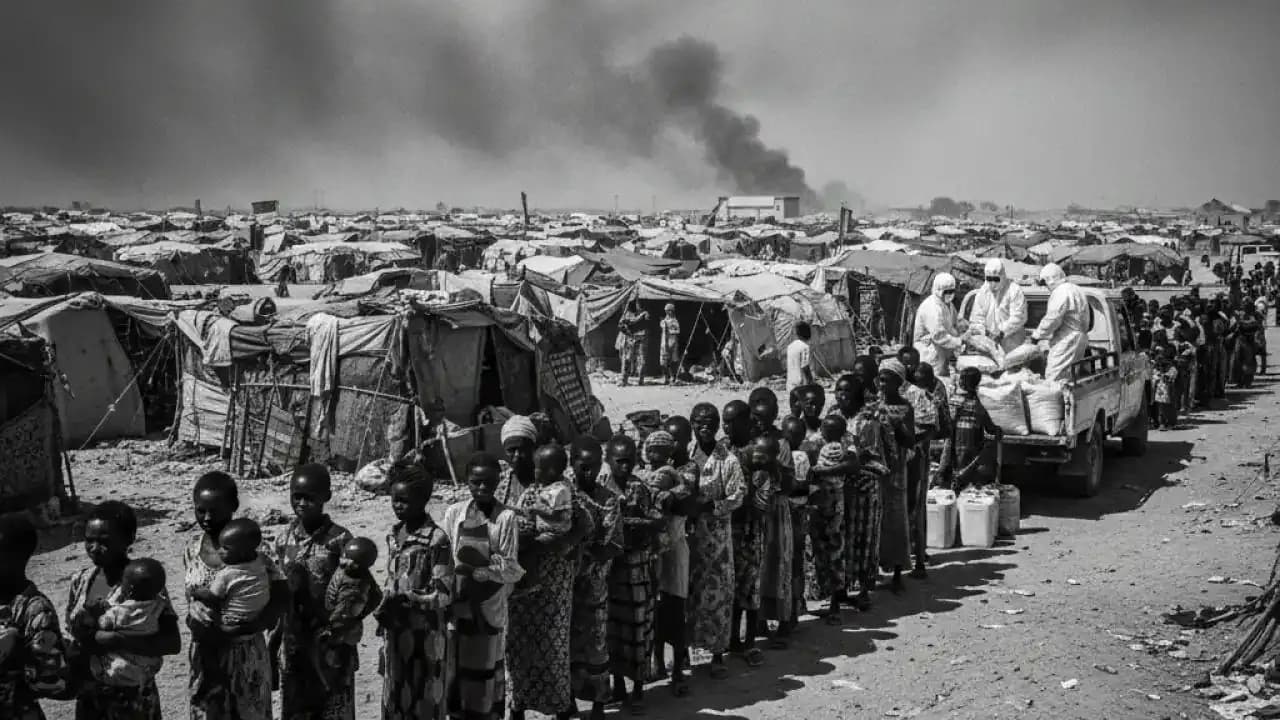
Sudan is careening through one of the deadliest and most complex phases of its multi year civil war. Fighting between the Sudanese Armed Forces (SAF) and the paramilitary Rapid Support Forces (RSF) continues to spread, even as famine grips key regions, international peace efforts falter, and Millions of civilians are pushed further into hunger and displacement. Recent violence including attacks on hospitals and schools underscores the catastrophic human cost of a conflict that has now lasted more than two and a half years and drawn Global attention and concern.
This report looks inside a conflict that is deepening by the month, where war and famine increasingly collide, offering a grounded analysis of how Sudan’s crisis continues to deepen despite international attention.
What Happened: Violence Escalates Despite Peace Talks
Sudan’s war initially ignited in April 2023 has evolved into a grinding, nationwide conflict marked by shifting frontlines and persistent violence. Recent reports detail lethal assaults on civilian infrastructure, including a devastating attack on a kindergarten and hospital in South Kordofan that killed over 100 People, many of them children, according to the World Health Organization.
Simultaneously, paramilitary forces have seized strategic assets such as the Heglig oil field, central to Sudan and South Sudan’s oil exports a blow to both nations’ economies and to efforts by SAF to stabilize its position.
Though diplomatic efforts continue including proposed involvement by U.S. leaders in peace negotiations fighting remains intense, and ceasefire proposals have Struggled to gain traction on the ground.
As the months pass, the conflict deepens, pulling more regions into violence and leaving civilians trapped between hunger, displacement, and collapsing institutions.
Why It Matters: A Nation on the Brink
The Sudan conflict is not merely a domestic struggle for power; it has profound implications for regional stability, global humanitarian systems, and international diplomatic norms. The war has:
- Expanded beyond traditional battle zones: Armed clashes are no longer limited to isolated fronts but now affect civilian centers and essential services.
- Shattered key economic infrastructure: Control battles over oil fields and trade routes have repercussions for both Sudan’s economy and the broader Horn of Africa.
- Exacerbated humanitarian pressures: Aid delivery struggles amid expanding hostilities and blocked access in conflict zones.
These factors underscore why the Sudan Crisis resonates far beyond its borders.
Humanitarian Impact: Hunger, Displacement, and Disease
Famine and Food Insecurity
Famine has been officially confirmed in parts of Darfur and South Kordofan, where conflict has blocked access and devastated food supplies. According to United Nations agencies, millions face extreme food insecurity a crisis driven by warfare, economic collapse, and disrupted agriculture. (UNICEF)
Recent estimates project that another 2.1 million people could be displaced by the conflict by the end of 2026, compounding existing pressures in what is already one of the world’s largest displacement crises.
Healthcare Collapse
Repeated attacks on health facilities have crippled Sudan’s medical infrastructure. The WHO and other humanitarian bodies report that more than two thirds of major hospitals in conflict zones are out of service, making routine care, emergency treatment, and epidemic response nearly impossible. (World Health Organization)
Cholera a disease that thrives in conditions of displacement and poor sanitation continues to spread, with tens of thousands of suspected cases reported across Sudan, worsening the public health emergency. (Wikipedia)
International Reactions: Diplomacy Grapples with Chaos
Global Efforts and Frictions
International diplomatic reactions have ranged from high level peace proposals to mounting pressure on regional actors. The United States, alongside Saudi Arabia, the UAE, and Egypt, has proposed a transitional peace plan aiming for a ceasefire and eventual political transition but implementation remains elusive.
The UN, African Union, and neighboring states have repeatedly called for humanitarian Access and a cessation of violence, yet hostilities continue to intensify in many areas. Observers warn that without credible enforcement, ceasefire agreements risk collapsing before they take hold.
Regional Spillover Risks
The conflict’s impact has spilled across borders. Millions of Sudanese have fled to neighboring Countries such as Chad, South Sudan, and Egypt overwhelming fragile health and food systems in host states and stretching humanitarian resources.
Recent tensions with South Sudan over transit fees on humanitarian shipments highlight the broader strain the crisis places on regional cooperation and aid delivery effectiveness.
Local Voices: On the Ground Realities
Civilians in the Crossfire
Local testimonies paint a stark picture of everyday life amid war: families fleeing shelling and hunger, children unable to attend school, and communities facing the loss of loved ones in Attacks on marketplaces, hospitals, and residential districts. These narratives reflect deep trauma and urgent need for Protective measures.
Despite the horrors, some communities report resilience and adaptation small market reopenings where fighting has eased, and grassroots support networks providing food and water but at levels far below what is required to sustain mass populations.
Regional and Global Implications
Sudan’s crisis feeds into broader geopolitical dynamics:
- It complicates Horn of Africa diplomacy, intersecting with conflicts in Ethiopia and South Sudan.
- It tests the capacity and resolve of international organizations to manage overlapping food, disease, and displacement emergencies.
- It influences global energy markets through disruptions in oil infrastructure crucial to Sudan and South Sudan’s economies.
As the world watches, the Sudan war poses critical questions about conflict resolution, responsibility to protect civilians, and the limits of regional mediation without enforceable peace mechanisms.
Possible Future Scenarios
1. Negotiated Ceasefire Followed by Political Transition
If international frameworks gain traction and both SAF and RSF sign onto a sustained ceasefire with enforcement mechanisms, there may be a pathway toward political transition and reconstruction. This outcome would require significant diplomatic pressure and robust peacekeeping guarantees.
2. Continued Fragmentation and Localized Violence
Without a comprehensive peace deal, the conflict may fracture further into regional warlordism, with multiple armed groups consolidating control over territories. This could deepen humanitarian fractures and prolong instability.
3. Escalation with Regionalization
The war could further regionalize if external actors deepen involvement whether through arms, logistics, or political backing potentially drawing in neighboring states and complicating any peaceful resolution.
Analyst Predictions
Conflict analysts warn that:
Related article: Stories Beneath the Ashes: How Ordinary Sudanese Endure Everyday Crises