


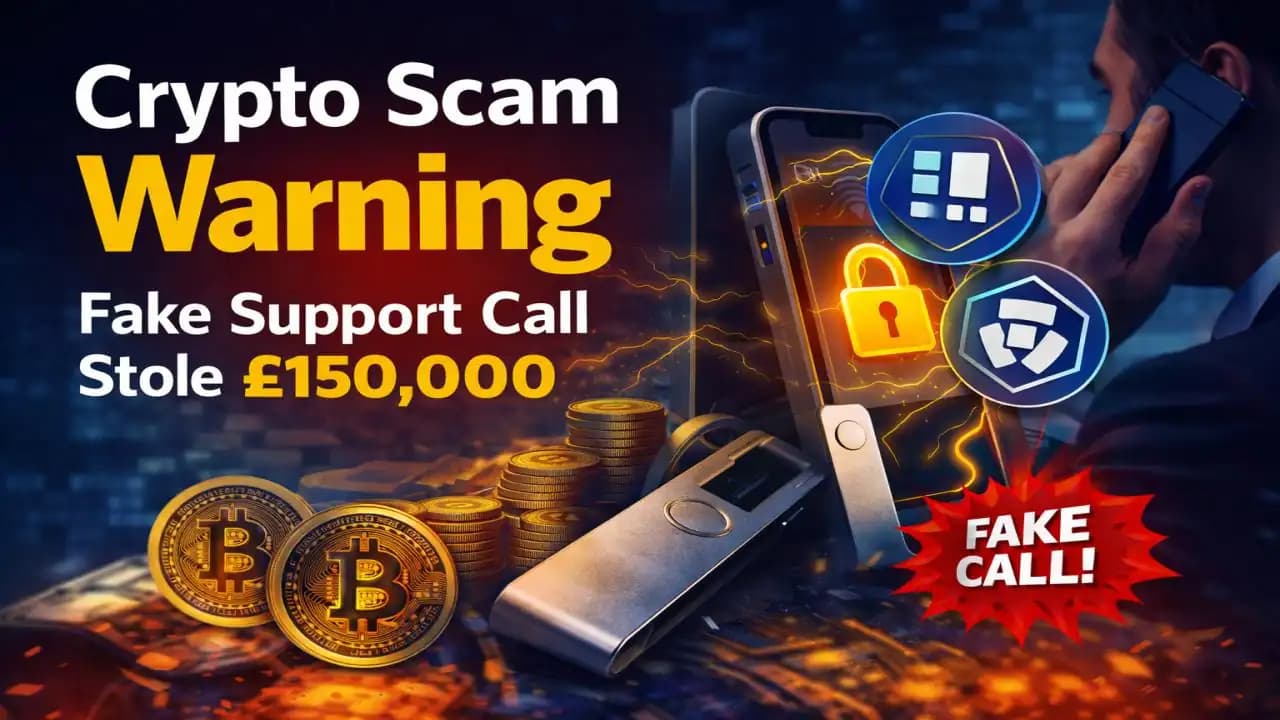
Crypto Scam Warning stories like this have been spreading more often in recent months, and one recent case shows how a simple phone call turned into a £150,000 loss within hours leaving a family shocked and confused about what went wrong.
What actually happened in this real crypto scam case
The situation started in a way that feels familiar to many users today.
A user’s father began receiving security alerts about suspicious login attempts from countries like Germany and Turkey. This alone created a sense of urgency something many people would take seriously.
Soon after, he received a phone call from someone claiming to be Crypto.com support.
The caller sounded convincing. Calm. Professional. Even authoritative.
They explained that:
- His Ledger wallet had been “corrupted”
- Immediate action was required
- A fix was available through a specific website
The victim was directed to a fake site and asked to replace his seed phrase.
That single step gave the scammers full control.
Within a short time, his entire crypto wallet was drained reportedly around £150,000, which had been saved as retirement funds.
Why this type of scam works so well on real users
This wasn’t a random attack. It was carefully designed to feel real.
What makes this kind of crypto scam effective:
- It starts with realistic triggers (login alerts)
- It uses trusted brands (Crypto.com, Ledger)
- It introduces authority figures (support agents, security teams)
- It creates time pressure
Most importantly, it targets a moment when the user is already worried.
The victim wasn’t careless he was reacting to what felt like a real security threat.
The critical mistake: sharing or replacing a seed phrase
The most important part of this scam is the seed phrase.
A seed phrase is:
- The master key to a crypto wallet
- The only way to recover access
- Completely private
In this case, the scammers:
- Directed the user to a fake website
- Generated a new seed phrase
- Asked him to replace his existing one
Once this happened, the attackers gained:
- Full wallet access
- Complete control over funds
- No need for passwords or verification
No company not Ledger, not Crypto.com, not any platform will ever ask you to change or share your seed phrase.
How crypto scams have evolved in 2025–2026
This type of attack is becoming more common, especially over the past year.
Previously, scams relied on:
- Emails
- Fake websites
- Obvious phishing links
Now, the pattern has shifted:
- Phone-based scams are increasing
- Attackers combine alerts + calls + fake support
- They use regional accents and local context
- They simulate real customer service interactions
In many cases, users report that the scammers:
- Know platform names
- Use technical language
- Guide victims step-by-step
This makes the experience feel legitimate even to experienced users.
What makes phone scams more dangerous than other scams
Phone scams create a different kind of pressure.
When someone is speaking to you directly:
- You feel urgency faster
- You are less likely to verify information
- You trust tone and confidence
In this case:
- The caller sounded professional
- The situation felt urgent
- The instructions seemed logical
That combination is what leads to quick decisions and irreversible actions.
Warning signs you should never ignore
Even well-designed scams leave clues.
Some signs from this case:
- Unexpected security alerts followed by a call
- A request to take immediate action
- Being told your wallet or account is “corrupted”
- Instructions to visit a specific external website
- Any request involving a seed phrase
If something feels rushed or forced, it usually is.
What to do if you receive a similar call
If you ever receive a call like this:
- Pause and disconnect
- Do not follow instructions immediately
- Open the official app or website yourself
- Contact support using verified channels
Never rely on:
- Incoming calls
- Links sent via SMS
- Instructions from unknown sources
Taking a few minutes to verify can prevent a lifetime loss.
Why stories like this matter for everyday users
This case isn’t rare anymore.
It reflects a growing pattern where:
- Scams target regular users, not just beginners
- Losses are often life-changing amounts
- Victims are often experienced but caught off guard
The emotional impact is also real:
- Shock
- Guilt
- Confusion
Many victims say the same thing:
“I knew better but it felt real.”
A final thought on staying safe
Crypto tools are designed to give users full control.
But that also means:
- There is no reversal
- No refund
- No recovery once access is lost
The safest habit is simple:
Never trust urgency. Never trust unsolicited support. And never share your seed phrase under any circumstance.
FAQs
1. Can a crypto company call me about my wallet?
No. Legitimate companies do not make unsolicited calls about your wallet security.
2. What happens if I share my seed phrase?
Anyone with your seed phrase can fully control and empty your wallet.
3. Are login alerts always real?
Not always. Scammers often send fake alerts to create panic and push you into action.
4. Can I recover funds after a crypto scam?
In most cases, no. Crypto transactions are irreversible once completed.
5. How can I verify a security issue safely?
Always check directly through the official app or website never through links or calls.