
Sudan public opinion is changing in ways few would have predicted just months ago. Amid one of the most severe humanitarian crises of the century, social trends in Sudan show emerging fractures but also remarkable resilience and Shifting public mood that reflect deeper Arab world sentiment. Recent poll results and surveys indicate not only how Sudanese people view their social reality today, but also how evolving attitudes may influence the broader region’s approach to conflict, identity, and political legitimacy.
As global attention lingers on the ongoing war, these Public perceptions measured Through comprehensive data and spirited online discourse offer a clearer picture of how ordinary citizens think about peace, justice, survival, and identity. Below we unpack what the latest insights reveal and why they matter for politics, society, and the future of Sudan and the Arab world.
What the Data Shows
Recent surveys and poll results paint a multifaceted portrait of Sudanese Public opinion today, spanning issues of peace, governance, social cohesion, and the war’s impact on daily life.
Together, these findings explain why new patterns of trust, skepticism, and social priorities are emerging among Sudanese communities under prolonged conflict.
Poll Findings Indicate Loss of Service Confidence and Rising Social Strain
In a broad sample of Sudanese citizens, around 66.4% reported that public services in areas affected by the war have not improved since the conflict began. More striking is the overwhelming 86.4% who reported deteriorating security conditions under the power of the paramilitary forces, with crime and violence escalating in towns and informal settlements. Critically, nearly 97% believe that these communities especially those in informal housing have been exploited in the war through economic inducements, forced recruitment, and mobilization along tribal lines. Roughly 88.8% see this exploitation as a driver of social tension and rising communal conflict. Meanwhile, 37.2% expressed pessimism that peaceful coexistence is achievable in the near future under current conditions. (Sagia Press)
Views on Political Structures and National Identity
Other surveys focusing on potential political outcomes, such as the formation of a parallel government, reveal significant divisions in public sentiment. Approximately 43.7% regard the idea of an alternate government as a tactical maneuver, not a strategic vision, while 36.7% view it as a strategic possibility if current political actors fail. Alarmingly, some 70% believe that such a move could effectively fracture Sudan into separate governing entities signaling real fears about national unity. (Sagia Press)
Representation and Demographic Spread
Poll demographics show a heavy representation from participants between 36 and 50 years old, suggesting the voice of mid life experience dominates many discussions around justice, governance, and social policy. Urban areas like Khartoum feature prominently in participation, while diasporic voices and out of country respondents also contribute a small but notable perspective, pointing to how global sentiment increasingly intersects with domestic views. (SalaaMedia)
Social Media Trends
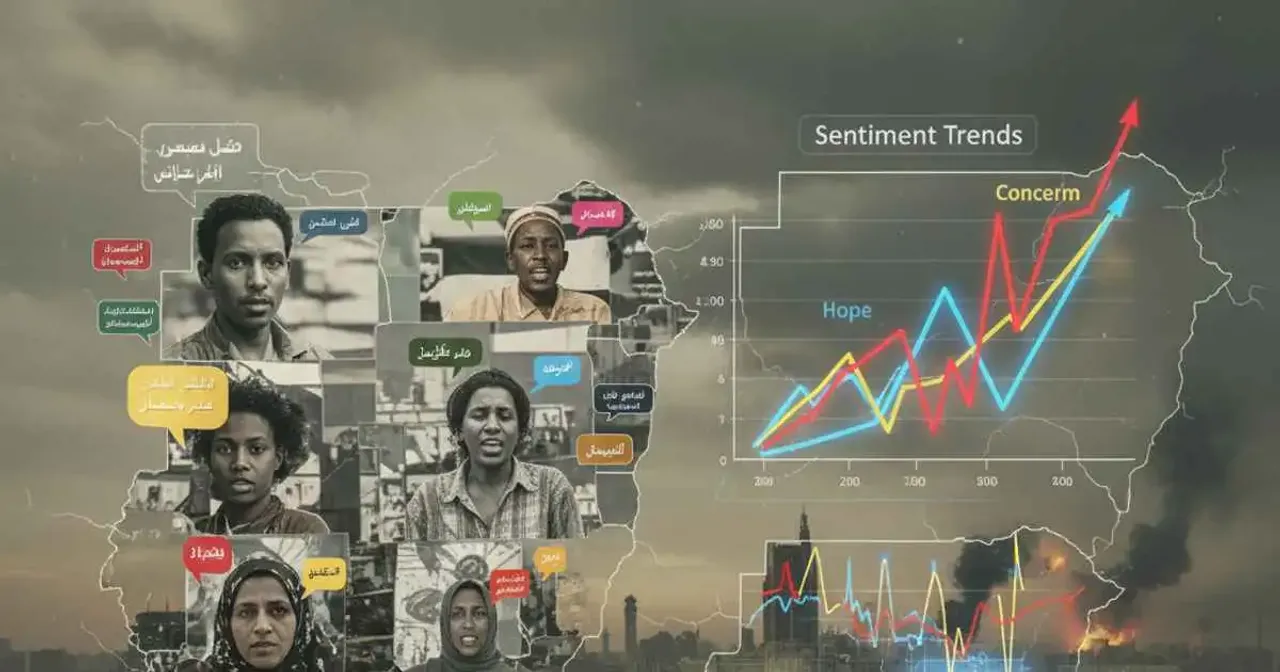
Social platforms have become virtual town squares for expressing Sudan public opinion revealing emotional nuances that numbers alone can’t capture.
Hashtags and Trending Themes
Across Arabic Twitter and Facebook discussions, hashtags linked to peace negotiations, humanitarian access, and calls for unity have surged, even surpassing polarized war narratives at certain moments. At the same time, hashtags that frame the conflict in ethnic or sectarian terms reflect a different current of sentiment that amplifies division rather than reconciliation.
WhatsApp discussions, where real time reactions spread quickly, tend to highlight daily security concerns, scarcity of basic goods, and the perceived invisibility of international mediators. In some groups, debates oscillate between expressions of anger at political leaders and nostalgic reminiscences of coExistence before the war.
Mood Shifts
Social sentiment analysis suggests shifting moods among different groups. Younger users often post with tones of frustration and disillusionment, especially regarding slow or absent political resolutions. Older participants tend to echo caution, calling for patience and incremental reconciliation steps. Across platforms, however, there is a recurring theme of longing for dignity, safety, and stability indicating a strong desire for normalcy amidst chaos.
Expert Interpretation
While polls capture snapshots of opinion, deeper analysis reveals why these trends are emerging.
Growing Distrust of Formal Institutions
Political analysts note that the prolonged civil conflict has eroded trust in central institutions and fragmented social capital. Long term instability, combined with everyday threats and economic collapse, has shifted public opinion away from confidence in any single political project or leadership.
Identity Stress and Social Fabric
Sociologists observe that the war has reshaped social identities. Once cohesive communities now grapple with narratives of betrayal, marginalization, and local rivalries. The emergence of projects aimed at reconstructing social trust such as community led peace initiatives suggests a growing recognition that the root problem extends beyond battlefield outcomes to the very fabric of social cohesion. (الجزيرة نت)
Media Influence and Misinformation
Media researchers point out that misinformation campaigns and content designed to inflame division have significantly influenced public discourse. In environments where internet shutdowns and digital censorship occur periodically, gaps in reliable information further skew public perception and frustration can quickly morph into distrust or despair. (Wikipedia)
Voices from the Public
Public opinion isn’t monolithic. Paraphrased sentiments from Sudanese citizens illuminate the emotional texture behind the numbers:
- “We feel abandoned by leaders and overlooked by the world; our survival matters here”a sentiment common among those in frontline conflict zones.
- “Peace seems distant while every conversation turns political first, human second”reflecting fatigue with polarized narratives.
- “We used to share meals and laughter before fear split our neighborhoods”a lament that captures loss of community trust.
- “If peace comes, it must start with justice and mutual acknowledgment of suffering”signaling a desire for restorative approaches rather than mere cessation of violence.
These voices, though diverse, converge on two themes: a craving for safety and a yearning for social integrity.
What It Means for Politics & Society
The implications of these shifting public sentiments are profound.
Governance Challenges
Declining confidence in institutions complicates any political settlement. Leaders advocating unity or federalism must contend with deeply felt skepticism and competing narratives of legitimacy.
Peace Negotiations
Poll results revealing fear of fragmentation underscore that any peace agreement must prioritize national cohesion before political compromise. Public mistrust of isolated delegations or externally driven plans may undermine broad based peace efforts unless locally rooted voices are central.
Economic and Social Policy
Public frustration over security and services signals that economic stabilization efforts cannot solely focus on macro metrics. Policies must address basic needs, equitable access to services, and livelihood opportunities to rebuild trust and reduce social volatility.
Regional & Global Significance
Sudan public opinion trends don’t exist in isolation; they mirror broader Arab world sentiment.
Shared Regional Narratives
Across Arabic speaking countries, long term conflicts and economic hardship have hardened public cynicism toward unresponsive elites. Sudan’s experience reflects a regional trend where citizens increasingly focus on survival, dignity, and social justice over ideological or partisan loyalty.
Global Reactions
International actors are closely watching Sudan, partly because of the scale of displacement and the implications for migration patterns beyond Africa. As public sentiment continues to evolve, global advocacy networks and policy circles are paying attention to how these perceptions might shape external intervention strategies or humanitarian priorities.
Contradictions or Split Sentiments
Sudan’s public opinion is not uniform. Key divides include:
- Generational Splits: Younger Sudanese often express urgency for structural change, while older groups emphasize preserving social fabric and cautious incrementalism.
- Urban vs Rural Views: Urban populations are more likely to demand political reform and accountability, while rural respondents often prioritize immediate security and basic services.
- Diaspora vs Domestic Sentiment: Those abroad tend to articulate broader geopolitical analyses, whereas domestic voices focus intensely on everyday survival and community safety.
These contradictions highlight that policy solutions must be multi dimensional to resonate across different demographic and social groups.
The Heart of the Trend: What’s Really Shifting?
Sudan public opinion reveals a transformation rooted in the everyday lived experience of war, survival, and social rupture. The most significant trend is not merely dissatisfaction with conflict actors, but a robust, if fractured, demand for dignity whether expressed through longing for peace, justice, or basic trust among citizens.
Public opinion today is shaped as much by heartbreak as by hope. What emerges next depends on whether political processes, community initiatives, and regional actors can engage these deep sentiments constructively.
As Sudanese people continue to voice their experiences, the question for decision makers is clear: Will future policies reflect the will of the public, or will they sideline the very voices that must shape Sudan’s next chapter?
Frequently Asked Questions
Why is Sudan public opinion shifting now?
Sudan public opinion is shifting due to prolonged conflict, deteriorating services, and growing frustration with institutional failure, leading citizens to reassess social priorities and political expectations.
How does the Arab world sentiment relate to Sudanese views?
Emerging Arab world sentiment of resilience, dignity seeking, and political skepticism mirrors trends seen in Sudan, where people emphasize trust, fairness, and survival amid crisis.
What role does social media play in shaping opinion?
Social media amplifies both hope and anger, serving as a platform for everyday citizens to share experiences but also making misinformation more impactful in polarized debates.
Can public opinion influence peace negotiations?
Yes broad based public sentiment demanding justice, unity, and inclusion can pressure negotiators to design agreements that prioritize social cohesion over narrow political bargaining.