
Arabic Literature is no longer confined to bookshelves or academic circles. Across Sudanese art spaces galleries, murals, performance halls, and digital platforms poetry and literary heritage are actively reshaping how culture is created, preserved, and shared. This convergence of Arabic literature, poetry, and Sudanese art matters now because it reflects deeper shifts in identity, memory, and creative resistance across the region.
For search driven readers, this article offers an evergreen explanation: why Arabic literary traditions are central to Sudanese artistic expression today, how poetry shapes visual and performance art, and what this cultural fusion signals for the future.
Why the Literary Revival Matters Right Now
Sudan has always been culturally layered, shaped by African, Arab, and Islamic influences. What feels new is the urgency with which artists are turning to Arabic literature and poetry as tools of meaning making.
Periods of political uncertainty, social change, and diaspora displacement often push societies to re examine their cultural foundations. In Sudan’s case, poetry and classical Arabic texts provide continuity. They anchor modern expression in something familiar while allowing artists to question, reinterpret, and even challenge inherited narratives.
For many creators, literature offers:
- A shared language across generations
- Moral and philosophical depth
- Cultural legitimacy in a global art market
This explains why Arabic poetry is increasingly visible in exhibitions, street art, music lyrics, and multimedia projects across Sudanese art circles.
Arabic Poetry as a Living Artistic Language
Arabic poetry has never been static. Its rhythms, metaphors, and symbolic density make it adaptable to visual and performative forms. Sudanese artists are not simply illustrating poems; they are translating poetic structures into new artistic languages.
In visual art, this may appear as:
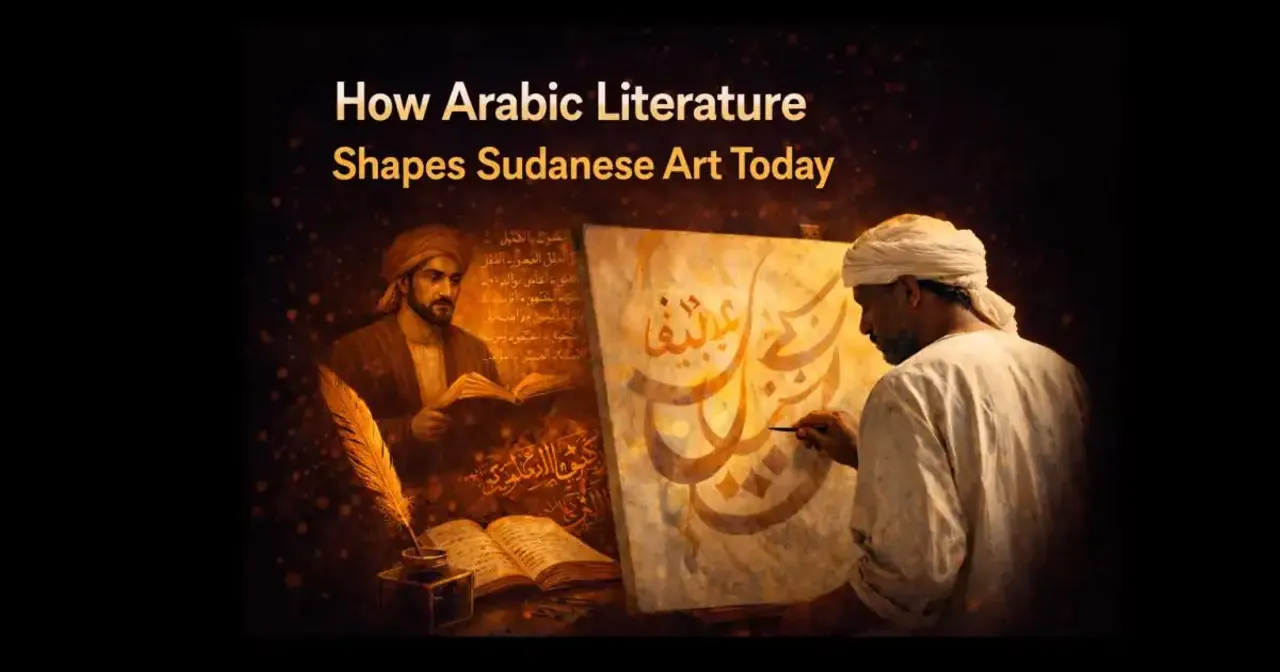
- Calligraphic fragments embedded into abstract paintings
- Poetic verses etched into sculptures or installations
- Symbol heavy imagery inspired by classical Arabic metaphors
In performance art and theater, poetic cadence influences pacing, movement, and silence. Even when words are absent, the structure of Arabic poetry its pauses, repetitions, and emotional arcs shapes the audience’s experience.
This is where Arabic literature becomes a framework, not just a reference.
Sudanese Art Beyond Decoration: Meaning, Memory, and Resistance
Sudanese art informed by literature tends to prioritize meaning over decoration. Poetry, especially, carries emotional and ethical weight. It speaks of exile, land, dignity, and faith themes deeply relevant to Sudanese lived experience.
Artists often draw from:
- Classical Arabic poetry for moral and spiritual grounding
- Modern Arabic literature for social critique
- Oral poetic traditions for rhythm and accessibility
This blend allows Sudanese art to remain locally rooted while globally legible. A viewer unfamiliar with Sudan’s history may still feel the emotional pull, even if the full literary reference unfolds later through explanation or research.
How Calligraphy Bridges Literature and Visual Expression
Arabic calligraphy deserves special attention. More than an aesthetic tool, it is a visual extension of literature itself. In Sudanese art, calligraphy frequently operates at the intersection of text and image.
Artists manipulate:
- Letter shapes to suggest movement or confinement
- Ink density to convey emotional intensity
- Fragmented verses to reflect memory loss or censorship
This approach transforms poetry into something spatial and tactile. Words are no longer just read; they are encountered.
Importantly, calligraphy also bypasses language barriers. Even viewers who cannot read Arabic often respond to its visual rhythm, reinforcing its role as a universal artistic medium.
Contemporary Artists and the Digital Shift
Digital platforms have accelerated the spread of literature inspired Sudanese art. Short poetic lines appear in digital illustrations, animations, and social media art projects, reaching audiences far beyond traditional galleries.
This shift creates new opportunities:
- Young poets collaborate with designers and filmmakers
- Literary themes reach diasporic Sudanese communities
- Arabic literature gains renewed relevance among younger audiences
At the same time, digital exposure raises questions about authorship, context, and depth. When poetry is reduced to a caption or visual motif, its meaning can flatten. Skilled artists counter this by layering references, encouraging viewers to explore the original texts.
Cultural Continuity in a Global Art Market
Global interest in Middle Eastern and African art is rising. Sudanese artists who draw from Arabic literature are often better positioned to present work that feels authentic rather than trend driven.
Literary grounding offers:
- Cultural specificity without isolation
- Intellectual depth valued by curators and collectors
- Resistance to homogenized global aesthetics
This does not mean Sudanese art is trapped in the past. On the contrary, literature provides a stable base from which experimentation feels intentional rather than derivative.
What This Fusion Means for the Future
The relationship between Arabic literature, poetry, and Sudanese art is likely to deepen rather than fade. Several developments are already visible:
- Interdisciplinary education
Art schools increasingly integrate literary studies into visual and performance training.
- Archival revival
Forgotten poets and texts are being rediscovered and reinterpreted through art.
- Diaspora influence
Sudanese artists abroad use literature to maintain cultural continuity while adapting to new contexts.
- Hybrid formats
Expect more installations, films, and digital works built around poetic narratives.
The risk lies in superficial use treating poetry as ornament rather than substance. The opportunity lies in thoughtful integration that respects both artistic and literary traditions.
Why This Topic Remains Evergreen
Arabic literature has survived centuries because it evolves without losing its core. Sudanese art draws strength from this adaptability. As long as questions of identity, belonging, and memory remain relevant, poetry and literature will continue to shape artistic expression.
For readers searching today, this is not just a cultural trend. It is a lens for understanding how Sudanese creativity responds to change, preserves meaning, and communicates with the world.
Frequently Asked Questions
How does Arabic literature influence Sudanese art today?
Arabic literature provides themes, symbolism, and structure that Sudanese artists translate into visual, performative, and digital forms.
Is poetry still relevant in modern Sudanese culture?
Yes. Poetry remains central, especially as a medium for social commentary, emotional expression, and cultural continuity.
Why is Arabic calligraphy important in Sudanese art?
Calligraphy visually embodies literature, allowing artists to merge text, emotion, and form in a way that transcends language barriers.
Does this literary influence limit artistic innovation?
No. It often enables deeper experimentation by grounding new ideas in a rich cultural framework.
How can global audiences engage with literature based Sudanese art?
Through exhibitions, digital platforms, and contextual storytelling that explains the poetic and literary references behind the work.