
Arabic Literature has become one of the most influential forces redefining Sudanese art today. This shift is not driven by nostalgia or academic preservation. Instead, it reflects a deeper cultural need to anchor modern artistic expression in language, memory, and shared identity at a time of social transformation.
For search driven readers, this article explains why Arabic literature and poetry matter now, how they shape Sudanese art across disciplines, and what this evolving relationship means for culture, creativity, and global relevance in the years ahead.
Why this topic matters in the current cultural moment
Sudanese art is undergoing a period of redefinition. Artists are navigating political uncertainty, displacement, and rapid digital change, while also facing growing global visibility. In such moments, creative communities often turn inward before speaking outward.
Arabic literature offers something rare: continuity. Poetry and prose connect generations, regions, and experiences through a shared linguistic and symbolic framework. For Sudanese artists, literature provides both stability and flexibility. It allows them to explore identity without being confined to fixed narratives.
This explains why Arabic poetry, storytelling, and literary symbolism are increasingly visible in galleries, public art, performance spaces, and digital platforms linked to Sudanese art.
Understanding the deep roots of literary influence
Arabic literature has long been central to cultural life across Sudan. Poetry readings, oral storytelling, and written texts historically shaped education, social values, and artistic sensibilities. What has changed is how these literary traditions are being used.
Rather than preserving texts as static heritage, artists are reinterpreting them as living systems of meaning. Literature becomes a method of thinking, not just a source of content. This approach allows Sudanese art to feel intellectually grounded while remaining emotionally accessible.
The result is work that speaks to lived experience rather than surface aesthetics.
Poetry as structure, not decoration
A common misconception is that poetry influences art only through quotes or visible text. In contemporary Sudanese art, poetry often functions at a deeper level.
Artists draw from poetic principles such as:
- Rhythm and repetition
- Compression of meaning
- Symbolic layering
- Emotional pacing
These elements appear in visual composition, performance timing, and even digital storytelling. A painting may follow the emotional arc of a poem without displaying a single word. A performance may mirror poetic cadence through silence and gesture.
This structural influence makes Arabic poetry an invisible architecture within Sudanese art.
Sudanese art as a space for memory and meaning
Sudanese art informed by Arabic literature tends to prioritize meaning over spectacle. Poetry carries ethical and emotional weight, addressing themes that resonate strongly with Sudanese society, including land, exile, dignity, and collective memory.
Literary influence allows artists to approach sensitive topics indirectly, using metaphor rather than confrontation. This method has several advantages:
- It invites reflection instead of polarization
- It preserves emotional nuance
- It encourages multiple interpretations
As a result, Sudanese art rooted in literature often feels timeless rather than reactive.
The role of Arabic calligraphy in contemporary practice
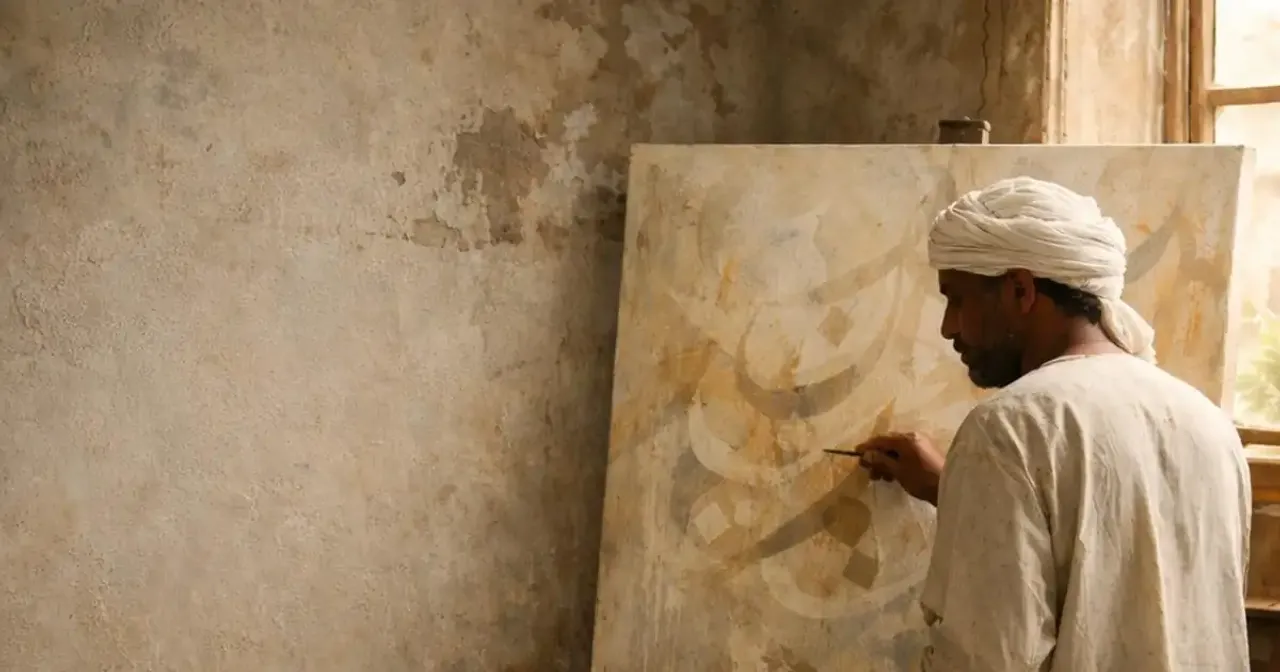
Arabic calligraphy occupies a unique position between language and image. In Sudanese art, it functions not merely as ornament but as a conceptual tool.
Artists manipulate letters, spacing, and form to express:
- Constraint and freedom
- Fragmentation of memory
- Continuity across time
Even viewers who cannot read Arabic often respond to the visual rhythm of calligraphy. This makes it a powerful bridge between local meaning and global accessibility, reinforcing the role of Arabic literature within visual culture.
Digital platforms and the expansion of literary art
The rise of digital media has accelerated the interaction between Arabic literature and Sudanese art. Short poetic lines now appear in digital illustrations, animations, and multimedia installations. Social platforms allow artists to reach audiences beyond geographic and institutional boundaries.
This shift creates new opportunities:
- Collaboration between poets, designers, and filmmakers
- Engagement with younger audiences unfamiliar with traditional formats
- Stronger connections with Sudanese communities in the diaspora
However, digital visibility also introduces risk. When poetry is reduced to visual fragments without context, meaning can be diluted. Artists who maintain credibility tend to balance accessibility with depth, encouraging audiences to explore the underlying literary sources.
Cultural credibility in a global art economy
As global interest in African and Arab art grows, Sudanese artists face pressure to adapt to international expectations. Arabic literature offers a form of cultural credibility that resists homogenization.
Literary grounding helps Sudanese art:
- Maintain cultural specificity
- Avoid trend driven aesthetics
- Communicate complexity without explanation overload
For curators, collectors, and institutions, literature based work often signals seriousness, research, and authenticity. This strengthens Sudanese art’s position within global cultural conversations.
What the future holds for this creative relationship
The relationship between Arabic literature, poetry, and Sudanese art is likely to deepen rather than fade. Several developments are already shaping the next phase:
- Cross disciplinary education
Art institutions increasingly integrate literary studies into creative training.
- Rediscovery of forgotten texts
Older poets and narratives are being reintroduced through contemporary art.
- Diaspora driven reinterpretation
Artists abroad use literature to maintain cultural continuity while adapting to new environments.
- Hybrid artistic formats
Expect more installations, films, and interactive works built around poetic structures.
The main challenge lies in avoiding superficial use of literature. The opportunity lies in treating texts as intellectual partners rather than decorative elements.
Why this topic remains evergreen for readers
Arabic literature has endured because it adapts without losing depth. Sudanese art draws strength from that same quality. As long as questions of identity, belonging, and cultural memory remain relevant, poetry and literature will continue to shape artistic expression.
For readers seeking understanding rather than headlines, this connection offers a lens into how culture survives, evolves, and speaks across generations.
Frequently Asked Questions
How does Arabic literature influence Sudanese art today?
It provides themes, symbolic structures, and ethical depth that guide visual, performative, and digital art practices.
Is poetry still relevant in modern Sudanese culture?
Yes. Poetry remains central as a tool for reflection, identity, and creative expression.
Why is Arabic calligraphy so prominent?
Because it visually embodies literature, allowing text and image to merge into a shared artistic language.
Does literary influence limit artistic freedom?
No. It often expands creative possibilities by offering a rich conceptual foundation.
How can global audiences engage with literature based Sudanese art?
Through emotional resonance, visual symbolism, and contextual exploration of the underlying texts.