

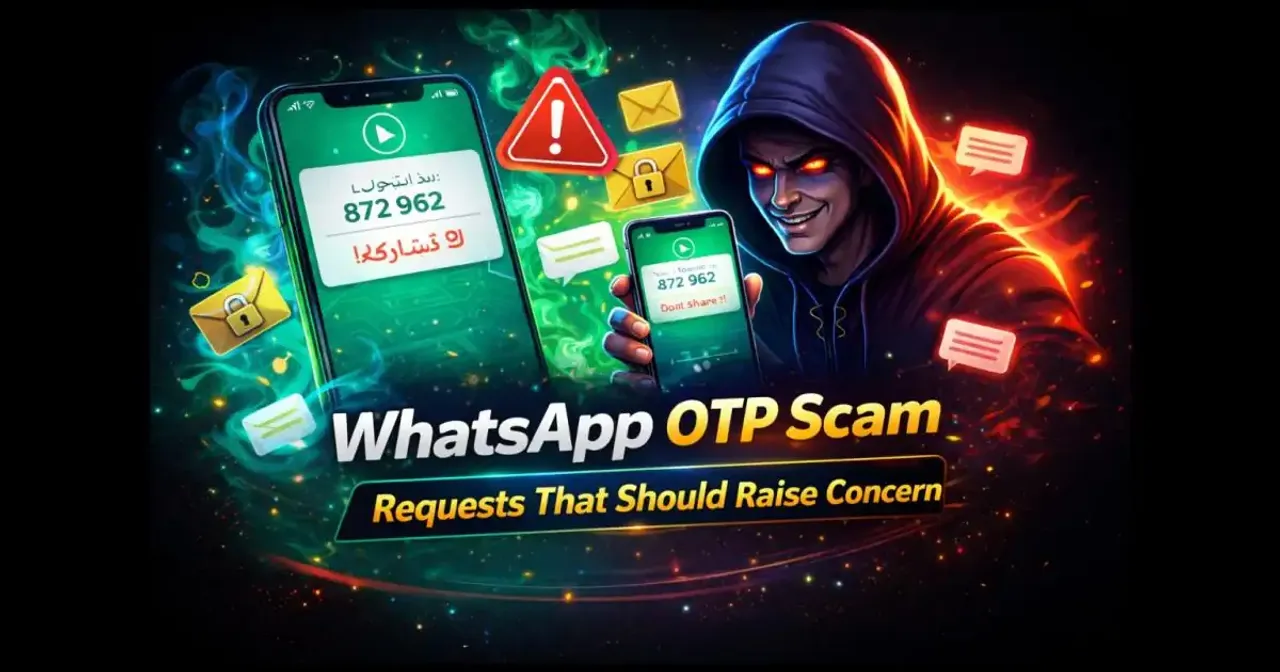
Received a WhatsApp verification code you didn’t request? Learn how OTP scams lead to account takeovers and how to protect your account. This scam messages don’t usually arrive with flashing red flags or obvious threats. They show up quietly, disguised as routine requests, friendly check-ins, or small favors that seem harmless in the moment. A six-digit code appears on your phone, followed by a message asking you to “confirm,” “help,” or “verify something quickly.” Nothing about it feels dramatic. And that’s exactly why it works.
Over the past few years, and especially recently as messaging apps have become central to daily life, OTP-based scams have grown more refined. They no longer rely on panic or technical jargon. Instead, they blend into everyday conversations, borrowing the tone of people we trust and the habits we’ve built around constant authentication prompts.
The quiet power of one-time passwords
One-time passwords, or OTPs, were created to make Accounts safer. They’re temporary, short-lived, and designed to add a second layer of protection beyond passwords. In theory, they’re a strong defense. In practice, they’ve become a social engineering shortcut.
The problem isn’t the technology. It’s the way OTPs feel. They arrive often. They disappear quickly. They don’t look personal. Over time, they lose their perceived importance. When something becomes routine, it becomes easier to misuse.
Scammers understand this psychology well. They don’t need to break encryption or exploit software flaws. They just need someone to treat an OTP like a casual message instead of a Security key.
Why WhatsApp is such a common setting
WhatsApp sits at the center of personal communication for millions of people. It’s where families talk, businesses coordinate, and communities stay connected. That closeness creates comfort and comfort lowers defenses.
Unlike email, WhatsApp Messages feel immediate and human. They come from contacts, not addresses. They carry profile photos, names, shared history. When a message arrives there, it doesn’t feel like “the internet.” It feels like real life.
In recent years, especially as WhatsApp has expanded into payments, business messaging, and account syncing, OTPs have become more common within the app ecosystem. That increased exposure creates more opportunities for misuse, particularly when users aren’t expecting a scam to happen inside such a familiar space.
The requests that should make you pause
What makes a WhatsApp OTP scam effective isn’t aggression. It’s subtlety. The requests are often framed as mistakes, favors, or technical confusion.
A contact might say they accidentally entered your number while setting something up. Another might claim they’re locked out of their account and need your help “just for a minute.” Sometimes the message is vague, rushed, or oddly casual. Other times, it’s polite and apologetic.
What connects these situations isn’t the wording, but the logic gap. There’s rarely a clear reason why your phone should receive someone else’s verification code. That inconsistency is the quiet warning sign most people overlook.
Familiar faces, unfamiliar intentions
One of the most unsettling aspects of these scams is that they often involve people you recognize. That’s because compromised accounts are frequently used to target new victims.
Once someone loses access to their WhatsApp account, the attacker gains something far more valuable than the account itself: credibility. Messages sent from a real profile bypass skepticism. They feel safe by default.
This creates a chain effect. One compromised account leads to another, and then another, each relying on existing trust. It’s not unusual for people to realize something went wrong only after friends start asking why strange messages came from their number.
The emotional cost of “just a code”
From the outside, sharing an OTP might seem like a small mistake. From the inside, it often feels much heavier.
Losing control of a messaging account can disrupt work, strain relationships, and create anxiety that lingers long after access is restored. There’s also embarrassmentespecially when others are affected as a result.
In today’s digital environment, accounts aren’t just tools. They’re extensions of identity. When that identity is misused, even briefly, it can feel deeply personal.
Why awareness hasn’t stopped the problem
By now, many people know they shouldn’t share passwords. OTPs, however, exist in a gray area. They’re not as clearly labeled as “private,” and they’re often framed as system messages rather than personal data.
Scammers exploit this ambiguity. They rely on moments of distraction: during work, late at night, or in the middle of a busy day. The goal isn’t to convince someone over time. It’s to get a quick response before doubt sets in.
As digital life becomes faster and more fragmented, these moments are easier to find.
The broader shift in digital risk
The rise of WhatsApp OTP scams reflects a larger change in how online threats operate. Modern scams are less about tricking systems and more about navigating social spaces.
Security used to be a technical problem. Now it’s a behavioral one. Understanding how trust flows through apps, how habits form, and how urgency alters judgment has become just as important as strong passwords or updated software.
In 2025, digital literacy isn’t about mastering tools. It’s about understanding contexts.
Why this matters beyond one app
Even if you feel confident using WhatsApp, the pattern behind OTP scams applies everywhere. Any platform that uses temporary codes can be targeted. The tactics move easily from one service to another.
What changes is the setting, not the strategy. Today it’s WhatsApp. Tomorrow it could be a different messaging app, a payment service, or a login tied to work or education.
Recognizing the pattern early makes it easier to spot, regardless of where it appears next.
Reframing how we see verification messages
One of the most effective ways to reduce risk is conceptual, not technical. It starts with changing how we think about OTPs.
They aren’t messages. They aren’t notifications. They’re keys. Temporary ones, yesbut keys all the same.
Once that mental shift happens, many scams lose their power. Requests that once seemed reasonable start to feel strange. Urgency loses its pull. The pause becomes automatic.
Trust, without being careless
None of this means treating every message with suspicion or withdrawing from digital communication. WhatsApp remains a valuable, everyday tool. Trust is still essential to how it works.
The balance lies in understanding where trust belongs. People can be trusted. Systems have rules. When someone asks you to break a system rule “just this once,” that’s the moment to step back.
Digital confidence isn’t about fear. It’s about clarity.
Looking forward
As platforms evolve, authentication methods will change. Codes may become longer, shorter, or replaced entirely. But as long as human judgment is part of the process, social engineering will remain.
The encouraging part is that awareness spreads quickly too. Conversations about these scams are more open now than they were a few years ago. Mistakes are discussed without as much shame. That cultural shift matters.
It’s how collective resilience forms.
A small pause that makes a big difference
Most WhatsApp OTP scams succeed not because people are careless, but because they’re human. They respond quickly. They help. They trust.
Slowing down for a few secondsjust long enough to question why a code is being requestedcan be enough to stop the entire chain. In a digital world built on speed, that pause is a powerful skill.
Frequently Asked Questions
What is a WhatsApp OTP scam?
It’s a scam where someone tries to trick you into sharing a one-time password sent to your phone, allowing them to access your WhatsApp account.
Why do scammers prefer OTPs over passwords?
Because OTPs feel temporary and less sensitive, making people more likely to share them without hesitation.
Can this happen even if I didn’t click any link?
Yes. Simply sharing the OTP is often enough for an account takeover, even without clicking anything.
Do these scams usually come from strangers?
Not always. Many messages appear to come from known contacts whose accounts were already compromised.
Is this problem likely to go away soon?
The tactics may change, but as long as verification codes exist, awareness will remain the most effective defense.