

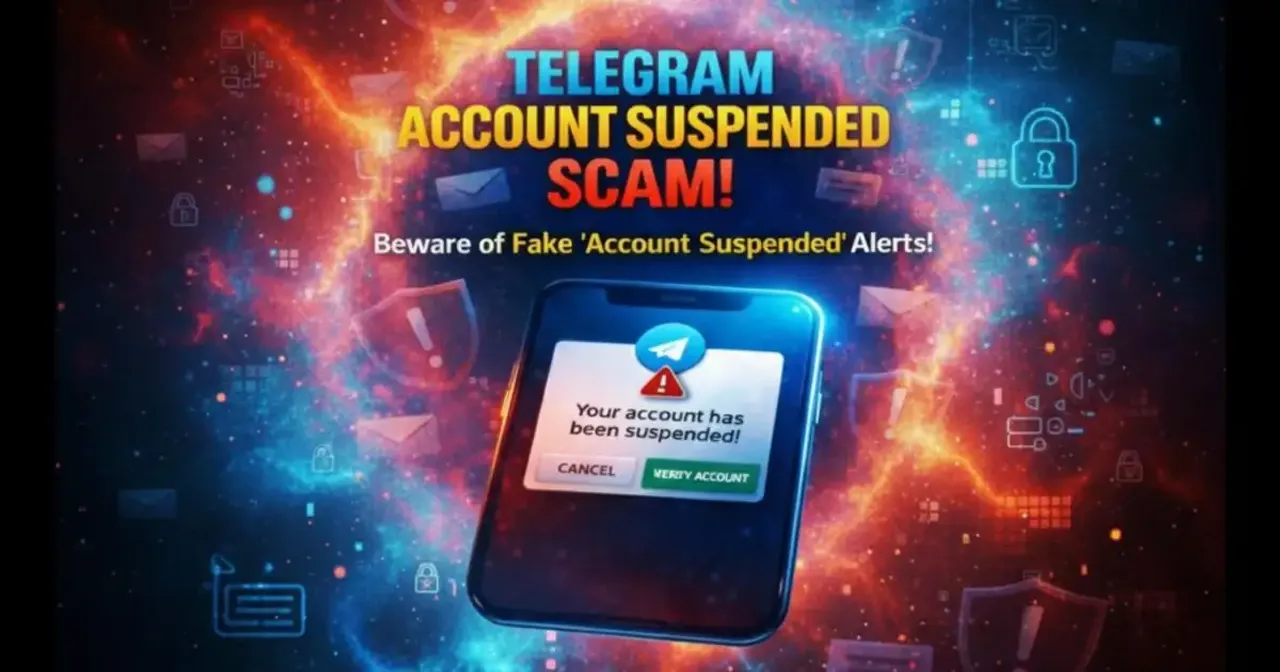
Telegram account suspended scam: Why That Sudden Warning Message Isn’t What It Seems
Telegram account suspended scam messages are designed to trigger one powerful emotion in seconds: panic. You open your phone, see a warning that your account has been restricted or suspended, and before you have time to think, you’re already imagining lost chats, blocked contacts, or a damaged reputation. That emotional jolt is exactly what scammers are counting on.
Over the past year, as Telegram has continued to grow globally and attract communities ranging from business groups to private circles, fake suspension notifications have quietly become more sophisticated. They don’t look like obvious spam anymore. They look official. Polished. Urgent.
And that’s what makes them effective.
The Anatomy of a Fake Suspension Notice
Most of these messages follow a familiar script. They claim your Telegram account violated community guidelines, engaged in suspicious activity, or triggered a security alert. The language feels formal. Sometimes it includes a reference number. Often, there’s a deadline: “Respond within 24 hours” or “Verify now to avoid permanent ban.”
The message usually contains a link. That link is the real objective.
In recent months, these scams have begun appearing not only as direct messages but also as forwarded system-style alerts, fake Telegram bots, or even emails that mimic Telegram’s branding. The visual details are often convincing logos, blue check-style icons, and system-like formatting.
But Telegram does not suspend accounts through random direct messages from unknown profiles. That disconnect is subtle, yet critical.
Why Suspension Scams Work So Well
Few things create anxiety faster than losing access to your digital identity. For many people in 2025, Telegram isn’t just a messaging app. It’s:
- A business communication channel
- A marketplace hub
- A community network
- A personal archive of years of conversations
When someone believes that access might disappear, rational thinking can narrow. The fear of losing something valuable overrides careful analysis.
Scammers understand this emotional reflex. They don’t need you to trust them long-term. They just need you to act quickly.
And urgency is their most reliable tool.
The Shift in Tone and Tactics
Earlier scam messages were often poorly written, filled with grammatical errors and suspicious links. Today, that’s not always the case.
Over the past year especially, phishing campaigns targeting Telegram users have become cleaner and more personalized. Some messages include your username. Others reference recent activity. A few even mimic Telegram’s own notification tone.
The design has evolved because users have evolved. People are more cautious now. So the deception has become more refined.
In some cases, the scam doesn’t even directly ask for your password. Instead, it directs you to “confirm your identity” or “appeal the suspension,” leading to a page that looks nearly identical to Telegram’s login screen.
Once credentials are entered, the account takeover can happen almost instantly.
What Actually Happens Behind the Scenes
When someone falls for a Telegram account suspended scam, the consequences aren’t always immediate or dramatic. Sometimes the attacker simply accesses private chats. Other times, they send spam from the compromised account, targeting contacts.
In more calculated scenarios, attackers may:
- Lock the user out by changing recovery details
- Impersonate the victim to request money from contacts
- Extract sensitive media or business-related files
- Use the account to distribute further phishing links
The damage isn’t just technical. It can be social.
Trust within groups can be disrupted. Business relationships can be strained. And in tightly connected communities, reputational harm spreads quickly.
The Psychology of Authority and Fear
These scams rely on two psychological triggers: authority and fear.
Authority comes from visual cuesofficial logos, system-style formatting, language that sounds institutional. Fear comes from the threat of losing access.
When combined, they create a convincing illusion of legitimacy.
People rarely question authority during moments of stress. That’s a human tendency, not a personal failure. In digital spaces, where communication feels immediate and reactive, that tendency becomes even stronger.
Understanding this dynamic helps explain why even experienced users sometimes click without hesitation.
Telegram’s Real Communication Patterns
Telegram, like most major platforms, does not randomly send direct messages threatening immediate account deletion. Real enforcement actions typically occur within the app’s system environment, not through unknown user accounts.
In recent years, platforms have made efforts to educate users about phishing attempts. However, as scammers adapt, the gap between official communication and imitation grows narrower.
That’s why context matters. A legitimate warning from a platform rarely demands instant password entry through an unfamiliar link. It rarely pressures you with dramatic countdown language.
The tone of real system messages tends to be structured, not alarmist.
Why This Scam Is Increasing Now
Telegram’s user base has expanded rapidly across different regions and age groups. With growth comes opportunitynot only for communities, but for fraud.
Scammers follow attention. Where users gather, scams emerge.
In 2024 and 2025, digital fraud has increasingly shifted toward impersonation tactics rather than brute-force hacking. It’s easier to trick someone into giving access than to break through technical defenses.
Suspension-themed phishing fits perfectly into this trend. It leverages platform growth, user dependency, and emotional urgency.
And because Telegram operates globally, language-specific scam versions have multiplied, targeting users in their native languages.
What Makes This Personally Relevant
It’s easy to assume that scams target only careless users. But digital deception doesn’t discriminate by intelligence or experience.
Anyone who relies on Telegram for professional networking, remote work, crypto discussions, or private group communities has something to lose.
In an era where messaging apps often double as business infrastructure, account access equals continuity. Losing iteven temporarilycan interrupt income streams, client relationships, or important conversations.
The Telegram account suspended scam matters because messaging platforms are no longer casual spaces. They’re integrated into daily routines and livelihoods.
The Broader Pattern: Suspension Scams Across Platforms
Telegram isn’t unique in this vulnerability. Similar “account suspended” phishing messages appear on Instagram, WhatsApp, Facebook, and email services.
The formula works because it targets something universal: fear of exclusion.
Digital accounts represent identity, access, and connection. Threaten that access, and attention spikes instantly.
In recent years, cybersecurity experts have observed that suspension-themed phishing campaigns generate higher engagement than generic prize or lottery scams. Fear outperforms greed in many cases.
Understanding this broader pattern helps reduce the element of surprise when such a message appears.
Building Calm Digital Awareness
Avoiding scams isn’t about constant suspicion. It’s about slowing down reaction speed.
Fraud thrives on urgency. Awareness thrives on pause.
If a suspension message appears, the key psychological shift is this: platforms rarely demand immediate action through external links. The most reliable place to verify account status is inside the official app interface itself.
But beyond technical steps, there’s a mindset shift. Digital literacy in 2025 means recognizing emotional manipulation patterns. The moment a message makes your heart rate jump, that’s the moment to step backnot forward.
The Future of Platform Impersonation
As artificial intelligence tools become more accessible, phishing messages are likely to become even more polished. Language errors will disappear. Branding imitation will improve.
At the same time, platforms are investing more in security layers, including device-based authentication and improved verification indicators.
The tension between deception and defense will continue.
But the human factorattention, emotion, and awarenesswill remain central.
Technology evolves. Psychology stays remarkably consistent.
A Final Reflection
A fake suspension notice is more than a nuisance. It’s a reminder of how intertwined digital platforms have become with identity and routine.
The Telegram account suspended scam succeeds not because users are naive, but because the fear of losing connection is powerful.
In a world where access equals participation, a sudden warning feels personal.
And that’s precisely why awarenessnot alarmis the most effective defense.
Frequently Asked Questions
Is Telegram sending real suspension messages through private chats?
No. Telegram does not typically suspend accounts by sending direct messages from random profiles. Official actions occur within the platform’s system environment.
What happens if I click a fake Telegram suspension link?
The link often leads to a phishing page designed to capture your login credentials. Entering your details may allow attackers to access your account.
How can I tell if a Telegram suspension message is fake?
Warning signs include urgent deadlines, requests to log in through unfamiliar links, or messages from unofficial accounts claiming to represent Telegram.
Are Telegram suspension scams increasing in 2025?
Yes. As Telegram’s user base grows, scammers increasingly target users with impersonation-based phishing campaigns.
Can someone recover a Telegram account after a phishing attack?
Recovery depends on how quickly the compromise is detected and whether additional security measures were enabled. Prompt action improves the chances of regaining access.