
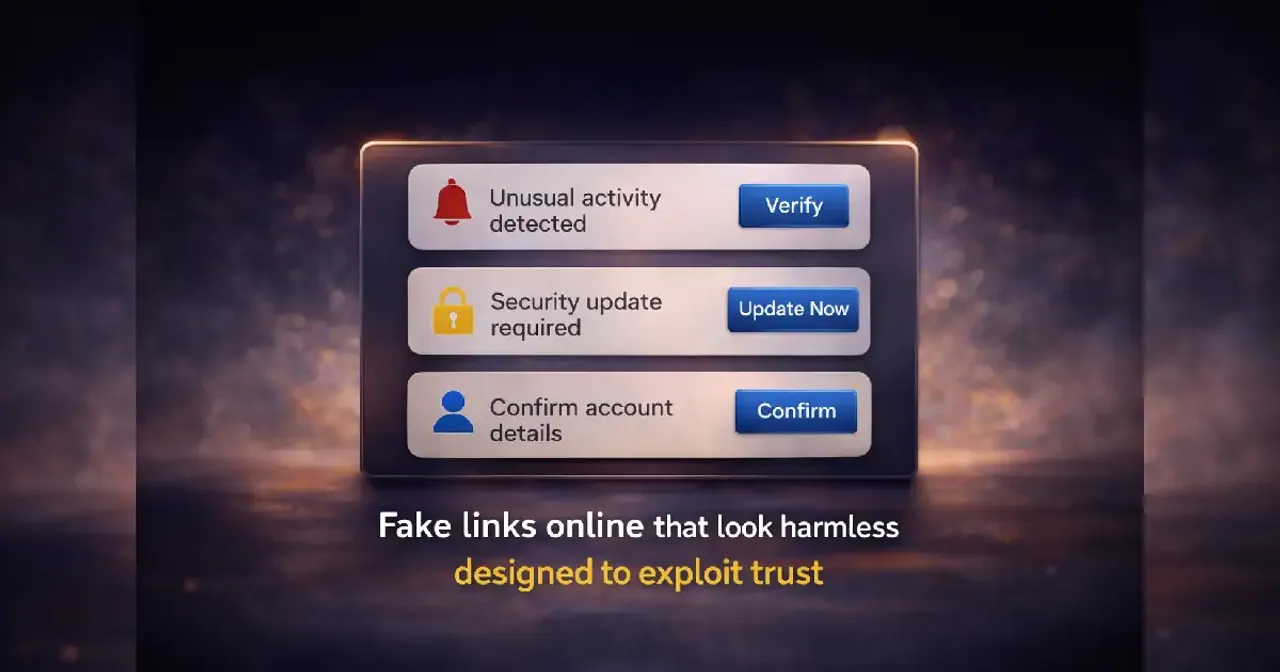
fake links online don’t succeed because people are careless. They succeed because they blend so well into everyday digital life that questioning them feels unnecessary. A message arrives, a button appears, a link looks familiar and the moment passes before doubt has time to form.
Most users don’t think of themselves as vulnerable. They’re experienced, active, confident online. Yet trust, when repeated often enough, turns into habit. And habits don’t ask questions.
The comfort of normal-looking links
Human attention is shaped by repetition. When we see the same patterns every dayblue links, rounded buttons, familiar domain namesour brains stop analyzing them. They become background objects, not decisions.
Fake links are designed to live in this background. They don’t look suspicious. They look like everything else.
A delivery update. A password reset. A shared document. None of these feel unusual on their own. In fact, they feel expected. When something matches expectation, skepticism switches off.
That’s not a technical failure. It’s a human one.
Trust borrowed from trusted places
One reason fake links online feel safe is because they appear inside platforms users already trust. Messaging apps. Email inboxes. Social networks. Workplace tools.
The link itself doesn’t need to prove anything. The environment does it for them.
When a message arrives in a familiar space, the brain assigns it the same level of trust as the platform hosting it. The link inherits credibility simply by proximity.
This is why fake links sent through known contacts or group chats are so effective. They don’t look like strangers. They look like part of the flow.
Speed trains the brain not to verify
Digital life rewards speed. Respond quickly. Click once. Move on.
Over time, speed becomes a value in itself. Pausing to check a link feels inefficient, even paranoid. When users are busy, tired, or multitasking, they rely on shortcuts.
These shortcuts are mental, not technical. “This looks right.” “I’ve seen this before.” “I’ll deal with it now.”
Fake links are designed to fit into these shortcuts perfectly. They don’t demand attentionthey slide past it.
The illusion of familiarity
A common trick behind fake links is visual familiarity. The text resembles a real brand. The colors match. The wording sounds official.
But familiarity isn’t the same as authenticity.
Most users don’t read links carefully. They scan them. They notice the first few characters, not the full structure. A domain that looks close enough passes the test.
Once the brain recognizes something it thinks it knows, deeper inspection feels unnecessary.
Authority signals without accountability
Fake links often come wrapped in authority language.
“Action required.”
“Security alert.”
“Final notice.”
These phrases don’t threaten; they imply responsibility. They suggest that ignoring the link would be irresponsible.
Authority signals work because they trigger compliance before reflection. The user’s focus shifts from questioning the link to resolving the implied issue.
The problem is that authority in digital space is easy to imitate. The tone feels official, but there’s no real accountability behind it.
Why warnings don’t always work
Many people have been told to “watch out for suspicious links.” But this advice often fails because fake links aren’t suspicious in the way people expect.
They don’t look broken. They don’t contain errors. They don’t feel aggressive.
In fact, the better a fake link is, the less it resembles the warnings people were trained to notice.
This creates a false sense of security. If nothing looks wrong, users assume nothing is wrong.
Emotional neutrality lowers defenses
Unlike older scams, many fake links online avoid emotional pressure. There’s no panic. No reward. No threat.
Just calm information.
This neutrality is deliberate. Emotional messages raise suspicion. Neutral ones feel professional.
A quiet request to “review activity” feels safer than a loud warning about danger. The calmer the message, the less likely users are to question it.
Habit replaces judgment
When users click dozens of legitimate links every day without consequence, clicking becomes automatic.
The brain learns: clicking is safe.
This learning is reinforced constantly. Most links don’t lead to harm. So when a harmful one appears, it doesn’t stand out.
Fake links succeed because they hide among thousands of harmless actions. They don’t interrupt behaviorthey exploit it.
Why experienced users are often targeted
It’s easy to assume that only inexperienced users fall for fake links. In reality, experienced users are prime targets.
They move fast. They manage multiple accounts. They handle frequent notifications.
They trust their ability to “spot problems.” That confidence reduces hesitation.
Fake links don’t challenge technical knowledge. They challenge attention.
The longer-term cost of blind trust
Even when no damage occurs, repeated exposure to fake links changes behavior.
Users become either overly suspicious or dangerously indifferent. Both extremes are exhausting.
Digital trust erodes. Every message becomes a potential threat. Or worse, every message becomes noise.
Neither outcome supports healthy digital engagement.
The future of deceptive links
Fake links will continue to evolvenot by becoming more complex, but by becoming more normal.
They’ll look like reminders. Updates. Conversations. Shared notes.
The danger won’t be in what stands out. It will be in what blends in perfectly.
Understanding this shift is essential for long-term digital awareness.
A better way to think about trust
Trust online shouldn’t be based on appearance. It should be based on context.
Where did this come from?
Why now?
Does this request make sense outside this message?
These questions don’t require technical expertise. They require a pause.
And that pause breaks the spell.
Awareness without fear
Recognizing why fake links online work doesn’t mean living in constant suspicion. It means understanding how habits formand how they can be used against us.
Most users aren’t fooled because they’re ignorant. They’re fooled because they’re human.
And once you understand that, the problem feels less personaland more manageable.
A quiet shift that makes a difference
The most powerful change isn’t learning new tools. It’s changing how much weight you give to familiarity.
When something feels normal, that’s when it deserves a second looknot because it’s dangerous, but because it’s easy to overlook.
In a digital world built on speed, noticing the ordinary can be a form of protection.
Frequently Asked Questions
What are fake links online?
They are links designed to look legitimate while leading users to unintended or harmful destinations.
Why do people trust them so easily?
Because they resemble everyday digital interactions and appear in trusted environments.
Are fake links always malicious?
Not always, but they are often used to collect information, redirect users, or manipulate behavior.
Do technical skills prevent this?
Not entirely. Attention and context matter more than technical knowledge.
What’s the simplest way to reduce risk?
Pause and consider the context of the link, not just how it looks.