

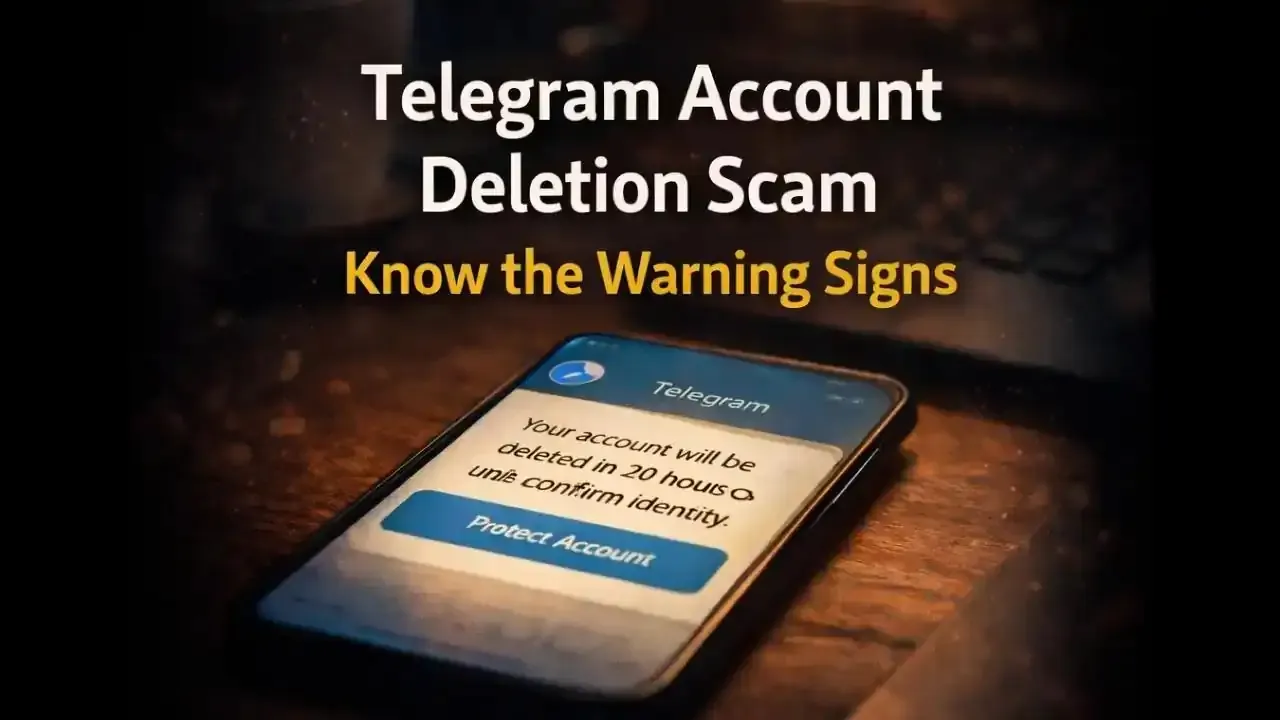
Telegram account deletion scam messages are appearing more frequently on phones lately often arriving through Telegram itself with a warning like “Your account will be deleted in 24 hours unless you verify.” For many users in recent months, the message feels urgent and confusing. It looks official, it mentions account security, and it often includes a link or button that promises to “protect” the account. But the reality behind these warnings is very different from what the message suggests.
Many people only realize something is wrong after pausing to think about it. Why would Telegram suddenly threaten to delete an account without warning? And why would the message ask for verification through an unfamiliar link?
These questions reveal an increasingly common pattern in digital messaging platforms.
Why are people suddenly receiving “your Telegram account will be deleted” messages?
For many users, the experience starts with a notification that feels strangely serious.
A message appears in Telegram or sometimes through SMS saying something like:
- “Telegram security notice: your account will be deleted due to unusual activity.”
- “Final warning: confirm your Telegram account to avoid deletion.”
- “Your Telegram profile will be removed within 24 hours.”
Sometimes the message even includes a Telegram-style logo or formatting to make it appear legitimate.
The reason people receive these warnings has little to do with their accounts. Instead, the messages are sent widely to random users in the hope that some will panic and respond quickly.
Telegram itself does not randomly send deletion warnings through private chats.
Yet the messages look convincing enough that many users hesitate before dismissing them.
Why the message feels believable at first glance
Most people rely on messaging apps like Telegram daily.
They use them for:
- conversations with friends
- group communities
- work discussions
- file sharing
- updates from channels
Because these apps hold years of conversations and contacts, the idea of losing access feels serious.
That emotional reaction is exactly what the message tries to trigger.
Instead of threatening something like money or passwords immediately, the message targets something more personal access to your digital conversations and identity inside the app.
The wording is usually calm but urgent.
For example:
“Your Telegram account is scheduled for deletion. Please confirm ownership.”
The message creates just enough concern to make people pause and consider clicking.
What actually happens when someone follows the message
The link included in these messages usually leads to a page designed to look familiar.
It may resemble a Telegram login page or verification screen.
Sometimes it asks for:
- a phone number
- a verification code
- account confirmation
In other cases it asks the user to “reconnect” the account.
To someone who is worried about losing their account, the request might appear normal.
But these pages are not connected to Telegram.
They exist only to collect login information or verification codes.
Why verification codes are the real target
Many users don’t realize how important Telegram verification codes are.
Whenever someone logs into Telegram from a new device, the platform sends a code to confirm the login.
This system normally protects accounts.
But in a Telegram account deletion scam, the message sender tries to trick users into sharing that code.
Once someone provides it, the attacker may attempt to access the account from another device.
The scam message doesn’t need complicated technology.
It relies mostly on timing and confusion.
Why this scam spreads easily on Telegram itself
Telegram has millions of public groups, communities, and open channels.
That openness is one of the platform’s biggest strengths.
But it also means that users can receive messages from people they do not know.
In some cases the warning message arrives through:
- direct messages from unknown accounts
- automated bots
- group messages
- forwarded alerts
Because Telegram supports bots and automated messaging tools, it’s easy for scammers to distribute identical messages to many users quickly.
The message itself is usually short and simple.
That simplicity helps it blend into the everyday flow of notifications.
Why the fear of losing an account works so well
Many scams focus on financial pressure.
This one focuses on something different: identity.
Your Telegram account often contains years of:
- conversations
- shared files
- group memberships
- contacts
For people who use Telegram for work or community discussions, losing the account would be disruptive.
That emotional weight makes the warning feel believable.
The message doesn’t need to threaten aggressively.
It only needs to create doubt.
Even a moment of uncertainty can lead someone to click a link without thinking carefully.
How messaging scams have changed in 2024 and 2025
In earlier years, scam messages were often easy to spot.
They contained spelling mistakes or exaggerated threats.
But in the past year, many of these messages have become more subtle.
The wording is cleaner.
The formatting looks familiar.
The tone sounds professional.
Some messages even mimic the style of real system notifications.
During 2024 and 2025, security researchers and digital safety communities have noted that scammers increasingly focus on account-related warnings rather than obvious financial scams.
The logic is simple.
People may hesitate before sending money.
But they may react faster when told their account will disappear.
Why Telegram is not the only platform where this happens
Although this article focuses on Telegram, similar messages appear across many platforms.
Users have reported comparable warnings on:
- email inboxes
- SMS messages
For example:
“Your WhatsApp account will be suspended.”
“Instagram account verification required.”
The theme is always the same: a sudden threat to the account.
But the goal behind these messages remains similar encouraging quick reactions before users think carefully.
Why mobile users are especially vulnerable to these messages
Most Telegram messages are read on smartphones.
And smartphone notifications create a very fast interaction pattern.
A message arrives.
You glance at it.
You tap it.
All within seconds.
Unlike desktop browsing, mobile messaging encourages quick responses.
That speed works in favor of the message sender.
The shorter and more urgent the message appears, the more likely someone might react instantly.
In addition, mobile screens show limited information about links.
A suspicious web address may not be obvious at first glance.
Why these messages keep appearing even if users ignore them
Some users assume that if they ignore the message once, it will disappear permanently.
But these campaigns often operate continuously.
Messages are sent repeatedly to large groups of users.
Some accounts sending them may be removed or blocked, but new ones appear quickly.
Because the messages require very little effort to create, they can spread widely across messaging platforms.
Even if only a small number of people respond, that is enough to keep the tactic active.
Recognizing the emotional trigger behind the message
One useful way to understand messages like these is to focus on the emotion they try to create.
In the case of the Telegram account deletion scam, the trigger is fear of losing access.
But the message itself rarely explains anything clearly.
It simply states that something serious will happen soon.
That urgency is what pushes people to react quickly.
When users pause and question the message, its logic often begins to fall apart.
Why would Telegram announce deletion through a random message?
Why would account security require clicking a link from an unknown sender?
Those questions often reveal the message’s weakness.
The bigger pattern behind account-related warnings
Across many digital platforms, the same psychological formula appears repeatedly.
The message claims:
- the account is at risk
- something must be verified
- the action must happen soon
The details change depending on the platform.
But the structure remains similar.
Once users recognize this pattern, it becomes easier to see these messages for what they are attempts to create urgency rather than provide real information.
When a moment of hesitation becomes the best protection
Most people interact with messaging apps dozens or even hundreds of times each day.
The habit of responding quickly becomes automatic.
But digital awareness often begins with a simple pause.
Looking at a message carefully even for a few seconds can change how it appears.
What first seemed urgent may begin to look vague.
What seemed official may start to look unusual.
And that moment of hesitation is often enough to prevent problems.
FAQs
Why did I receive a message saying my Telegram account will be deleted?
Messages claiming your Telegram account will be deleted are often sent widely to many users. They do not necessarily mean there is any issue with your account.
Does Telegram send account deletion warnings through private messages?
Telegram typically handles account issues through its official systems rather than random direct messages. Unexpected warnings in chats are often suspicious.
What is the goal of a Telegram account deletion scam?
The main goal is usually to convince users to share login details or verification codes by creating urgency about losing their account.
Why are these Telegram messages becoming more common recently?
With more people using messaging apps in 2024 and 2025, scammers increasingly focus on account-related warnings because they trigger fast reactions.
Can these messages appear on platforms other than Telegram?
Yes. Similar messages can appear on WhatsApp, Instagram, email, and SMS. The wording changes, but the tactic of warning about account problems remains similar.