

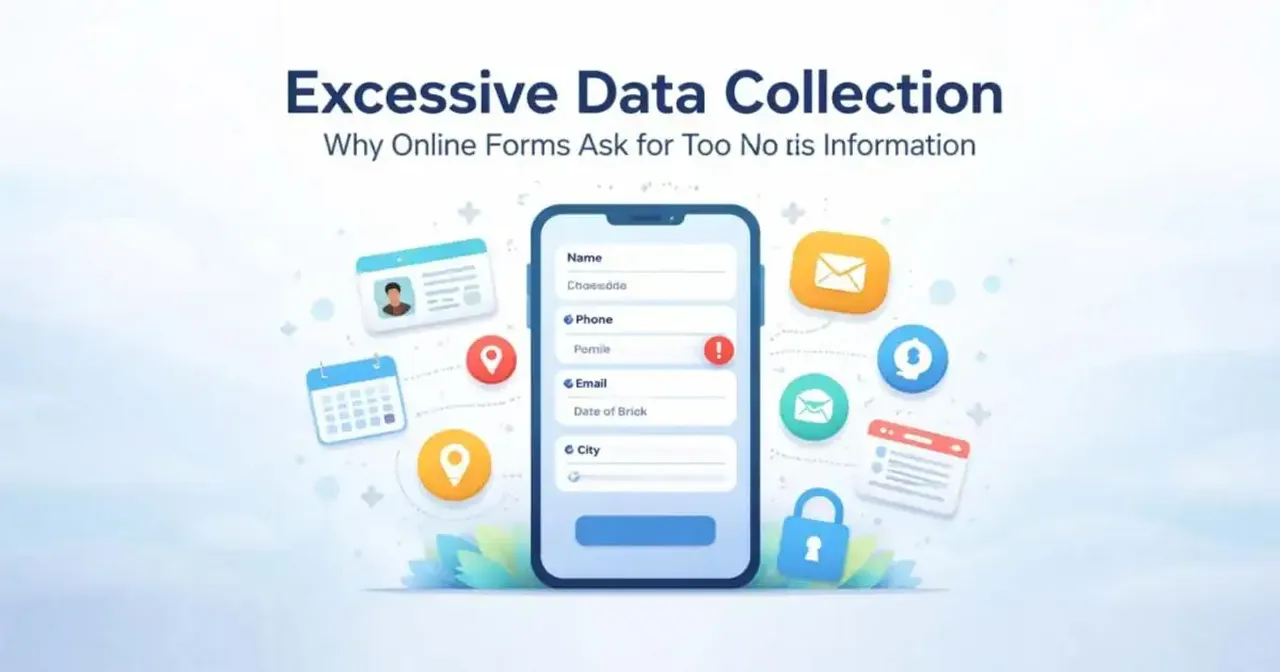
excessive data collection has quietly become part of everyday digital life. You open a simple sign-up form maybe for a newsletter, a discount code, or a free webinarand before you know it, you’re being asked for your full name, phone number, date of birth, city, job title, and sometimes even identification details. For something that seemed minor, the questions feel surprisingly personal.
Most of us pause for a second. Then we fill it out anyway.
Over the past few yearsespecially as online services have expanded rapidly across regions like the Middle East and North Africadigital forms have multiplied. From e-commerce platforms to education portals and fintech apps, the number of data fields has grown alongside the services themselves. But why are so many platforms asking for more information than they genuinely need?
The answer isn’t always sinister. But it’s rarely accidental.
When “Optional” Doesn’t Feel Optional
At first glance, online forms seem straightforward. They exist to help companies provide a service. You give your email, they send updates. You provide an address, they ship your order.
Yet many forms go beyond functional necessity. A simple download might require demographic information. A basic account creation might request a phone number even when email verification would suffice. In some cases, fields are marked “optional,” but the interface subtly nudges you to complete them anyway.
This is where the tension begins.
In theory, digital platforms are guided by principles of relevance and necessity. In practice, they often collect far more than what is needed for the immediate transaction. The reasons are layeredcommercial, analytical, psychological, and sometimes cultural.
The Business Incentive Behind Bigger Forms
Data has become one of the most valuable assets in the modern economy. Not just for advertising giants, but for small startups, educational platforms, and retail brands trying to understand their audience.
More data allows companies to:
- Segment users more precisely
- Personalize content and offers
- Measure engagement trends
- Build long-term marketing strategies
When a company asks for your job title or income range, it may not be essential to the service you’re accessing. But it helps refine targeting. In 2025, personalization is no longer considered a luxury featureit’s expected. And personalization runs on information.
In growing digital markets, including Arabic-speaking regions where online adoption has surged in recent years, businesses often feel pressure to “gather now, optimize later.” The logic is simple: once you have the data, you can always find a use for it.
Whether that approach aligns with user expectations is another matter.
The Quiet Absence of Data Minimization
There’s a principle in privacy law known as data minimization. At its core, it means collecting only what is strictly necessary for a specific purpose.
But in many parts of the world, this principle is inconsistently applied. Some regions have strong regulatory frameworks. Others are still developing digital governance structures. Even where regulations exist, enforcement varies.
As digital services expand rapidlyespecially across mobile-first marketsspeed often wins over restraint. Forms are built quickly. Templates are reused. Fields are added “just in case.” Rarely are they audited for necessity.
Over time, what began as optional data becomes standard.
This isn’t always malicious. Sometimes it’s simply habit. Designers copy competitors. Developers include extra fields because the database allows it. Marketing teams request additional insights. Gradually, the form grows.
Cultural Expectations and Trust Dynamics
In certain markets, including parts of the Arab world, identity verification has historically played a strong role in both government and financial processes. As digital platforms mature in these regions, some organizations replicate traditional documentation patterns in online form.
Users may be asked for national ID numbers or detailed personal information not because it’s required for the service itself, but because institutions are accustomed to comprehensive data collection.
At the same time, trust plays a complex role. In some contexts, users expect formal processes and may associate more detailed forms with legitimacy. In others, lengthy forms create suspicion.
The balance between professionalism and intrusion is delicateand often misunderstood.
Convenience vs. Control
There’s also a psychological layer. Digital platforms are designed to reduce friction. Autofill tools make long forms feel shorter. Social logins allow data to transfer instantly. Many users don’t manually type each field anymore.
This ease can blur awareness.
When the effort required to share information decreases, the perceived value of that information also shifts. A date of birth entered with two clicks may feel insignificant. But aggregated across millions of users, it becomes powerful.
In recent years, public conversations around privacy have grown louder. People are more aware of how information can be analyzed, monetized, or shared across ecosystems. Yet behavior hasn’t fully aligned with awareness. Convenience still wins most of the time.
The Hidden Cost of Overcollection
Why does excessive data collection matter beyond personal discomfort?
Because data rarely stays isolated.
Information can be:
- Combined with other datasets
- Shared with third-party partners
- Used to build behavioral profiles
- Stored long after the original purpose ends
Even when companies operate ethically, large data repositories increase exposure to risk. Cybersecurity incidents remain a reality globally, and in recent years, digital breaches have affected organizations of every size.
The more information stored, the more attractive a target becomes.
There’s also a long-term implication: digital footprints are cumulative. A single form may seem harmless. Dozens over time create detailed identity mapsoften more comprehensive than users realize.
Why It Feels Hard to Push Back
If many users feel uncomfortable sharing unnecessary information, why don’t they simply refuse?
Part of the answer lies in power dynamics. Access to digital servicesbanking, education, job applications, government portalscan depend on compliance. Refusing to provide requested data may block participation entirely.
There’s also uncertainty. It’s not always clear which fields are genuinely required and which are strategically included. Privacy policies are often lengthy and difficult to interpret. Terms like “may share with trusted partners” leave room for ambiguity.
In fast-moving digital environments, most people choose efficiency over investigation.
The Shift Toward Conscious Data Design
Encouragingly, awareness around responsible data practices has grown significantly over the past few years. Companies are increasingly adopting privacy-by-design frameworks. Regulators in several regions have introduced clearer guidelines around consent and proportionality.
Younger digital audiences, especially, show heightened sensitivity to how their information is handled. Platforms that demonstrate restraint often build stronger long-term loyalty.
Minimalist forms are becoming a subtle signal of respect.
Instead of asking for everything upfront, some services now collect information progressivelyonly when it becomes necessary. Others clearly explain why a particular field exists. Transparency changes perception.
The conversation is evolving from “How much can we collect?” to “How little do we truly need?”
Why This Matters in Daily Life
For individuals, digital literacy increasingly includes understanding data dynamics. Not from a place of fear, but from awareness.
Every online interaction contributes to a broader personal profile. Shopping habits, educational interests, geographic movements, professional networksthese pieces accumulate quietly.
When platforms request more than necessary, it shifts the boundary between service and surveillance. Recognizing that boundary empowers users to pause and reflect.
In regions experiencing rapid digital transformation, this awareness is especially relevant. As online banking, telemedicine, and e-learning expand, the standards set today will shape expectations for years to come.
The question isn’t whether data collection will continueit will. The real question is whether it will remain proportional.
Looking Ahead: A More Balanced Digital Future
Technology in 2025 is smarter, faster, and more integrated than ever. Artificial intelligence thrives on data richness. Personalization engines improve with detailed inputs. Businesses compete on insight.
Yet trust has become just as valuable as information.
Platforms that ignore user boundaries risk reputational damage. Those that prioritize thoughtful collection often stand out in crowded markets. In the long run, transparency may prove more sustainable than volume.
The digital future doesn’t require less innovation. It requires clearer intention.
When online forms ask for more than necessary, it reflects a broader tension in the modern internet: between opportunity and overreach, between personalization and privacy, between growth and restraint.
Awareness doesn’t mean rejecting technology. It means understanding the invisible exchange taking place every time we click “Submit.”
FAQs
Why do websites ask for information they don’t seem to need?
Often, additional data helps with marketing, personalization, analytics, or future service expansioneven if it isn’t essential to the immediate transaction.
Is excessive data collection illegal?
It depends on local laws. Some regions enforce strict data minimization rules, while others have developing or limited regulatory frameworks.
Does providing extra information increase privacy risk?
More stored data can increase exposure in case of breaches or misuse, especially if combined with other datasets.
What is data minimization?
Data minimization is the principle of collecting only the information necessary for a specific, clearly defined purpose.
Why are digital forms getting longer in recent years?
As online services expand and competition grows, companies seek deeper insights into user behavior, which often leads to broader data collection practices.
The next time a simple form feels surprisingly detailed, it’s worth noticing. Not with alarmbut with curiosity. Behind each additional field lies a choice about how much of ourselves we are willing to exchange for access, convenience, or connection.