

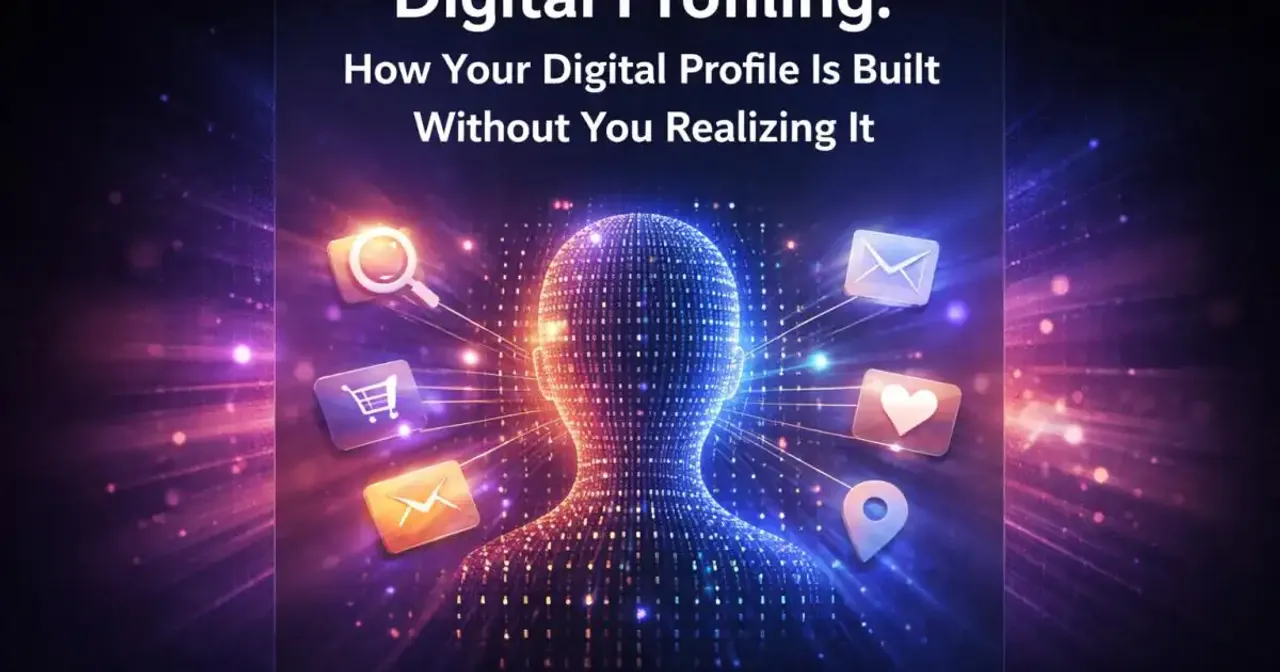
Digital profiling happens quietly in the background of everyday life, shaping a version of you that exists entirely in data. It doesn’t ask for a formal introduction. It doesn’t require a dramatic breach. It unfolds through ordinary actions scrolling, searching, pausing on a video for a few seconds longer than usual. In 2025, when nearly every interaction leaves a trace, digital profiling has become less about surveillance in the cinematic sense and more about pattern recognition at scale.
Most people don’t notice it because nothing obvious seems to change. Your apps still work. Your feed still loads. Your inbox still fills. But behind those familiar screens, something else is being assembled.
A portrait made of behavior.
The Invisible Trail of Small Actions
Every digital interaction generates metadata. Not just what you click, but how long you hover. Not just what you buy, but what you considered before deciding. Not just what you post, but who engages and when.
These fragments accumulate across devices and platforms. A late-night search about travel destinations. A sequence of fitness-related videos watched in one sitting. A few articles about career transitions bookmarked over several weeks.
Individually, each action feels trivial. Together, they form a narrative.
Digital profiling doesn’t rely on dramatic declarations. It reads patterns in repetition. It identifies rhythms in your activitywhen you’re online, what topics hold your attention, which types of content you scroll past quickly.
Over time, the system becomes less reactive and more predictive.
Beyond What You Share Publicly
Many people assume profiling is based on what they explicitly publish: photos, bios, posts. While those elements matter, they represent only a surface layer.
The deeper layer is behavioral data.
In recent years, especially with the expansion of AI-driven analytics, platforms have refined their ability to interpret subtle signals. How quickly you type. Whether you open emails immediately or hours later. Whether you prefer reading long-form articles or short summaries.
Even the device you useits model, operating system, language settingsadds context. Location patterns, derived from IP addresses or app permissions, help map routine movement.
Digital profiling today is less about identity in the traditional sense and more about probability. What are you likely to click next? What are you likely to purchase? What kind of messaging resonates with you?
It’s less about who you say you are and more about how you behave.
The Role of Algorithms in Building the Profile
Algorithms are not neutral observers. They categorize, compare, and cluster.
Imagine millions of users with overlapping habits. The system doesn’t need to know your name to identify that you resemble others who recently searched for similar content. It places you within segmentsbroad or narrowbased on statistical similarity.
In 2025, segmentation has become increasingly granular. Instead of broad categories like “sports enthusiast” or “tech reader,” profiles can reflect nuanced combinations: users who read about sustainable fashion, follow small business accounts, and watch short financial explainer videos late at night.
These micro-patterns inform what you see next.
The feedback loop is subtle. You engage with certain content, the system shows you more of it, your interests appear reinforced, and the profile deepens.
Data That Travels Between Platforms
One of the less visible aspects of digital profiling is how data flows beyond a single app.
Third-party trackers, embedded analytics tools, and advertising networks create connections between sites. A product you view on one platform might appear as a recommendation on another. An article you read on a news site might influence the ads you see in a social app.
This interconnectedness has intensified over the past few years as digital ecosystems have grown more integrated. Even as privacy regulations evolve in various regions, data partnerships and aggregated insights continue to shape user experiences.
You may think you are interacting with separate services. From a data perspective, those services may be part of a broader web.
The profile is not built in one place. It is assembled across many.
Predictive Models and Future Behavior
Perhaps the most striking dimension of digital profiling is its predictive power.
Based on historical data, systems can estimate future preferences. They can anticipate when you might be planning a trip, considering a major purchase, or exploring a new hobby.
This isn’t magic. It’s pattern analysis at scale.
For example, a user who begins searching for apartment listings, reading relocation guides, and comparing utility providers within a short period signals a likely move. Advertisers respond accordingly. So do recommendation engines.
The profile becomes forward-looking. It doesn’t simply reflect who you have been; it models who you might become.
That can feel convenient. It can also feel unsettling.
Why Users Rarely Notice
The process is gradual. There’s no notification that says, “Your behavioral profile has been updated.”
Instead, the changes appear as subtle shifts in content. More relevant ads. Articles that align with recent searches. Suggested connections that share overlapping interests.
In many cases, the personalization feels helpful. It reduces noise. It surfaces relevant information faster.
The trade-off is often invisible.
Digital profiling operates within systems that are designed to feel seamless. When recommendations align with your interests, you experience efficiency, not scrutiny.
That’s why awareness tends to lag behind capability.
The Emotional Dimension of Being Profiled
Beyond marketing implications, there’s a psychological layer.
When feeds consistently reflect certain themescareer ambition, fitness culture, luxury travelit can reinforce particular identities. The content you see shapes perception of what is normal, desirable, or urgent.
If your profile suggests financial anxiety, you may see more content about budgeting or side hustles. If it reflects interest in parenting, more child-related products and advice appear.
Over time, the curated environment can narrow perspective. It becomes easier to remain within familiar digital neighborhoods.
This isn’t inherently harmful. But it does influence how we see ourselves and the world.
Digital profiling, in this sense, shapes narrative as much as it responds to it.
The Business Incentive Behind the System
It’s important to recognize that profiling is not an abstract technological curiosity. It is tied to economic models.
Many online services operate on advertising revenue or engagement metrics. The more accurately a platform can predict user behavior, the more valuable its advertising space becomes.
Personalization increases click-through rates. It keeps users engaged longer. It reduces friction between curiosity and purchase.
In 2025, as competition between platforms intensifies, refined data insights are a strategic advantage. The better a system understands its users, the more efficiently it can match content, products, and messaging.
This doesn’t imply malicious intent. It reflects a business logic built around data-driven optimization.
Understanding that logic helps explain why digital profiling is so pervasive.
What This Means for Personal Growth
In a world shaped by algorithmic curation, digital literacy becomes part of personal development.
Recognizing that your online environment is tailored encourages a more reflective mindset. It invites questions: Why am I seeing this? What patterns might have led here? What assumptions are being made about me?
These questions are not about paranoia. They are about perspective.
When users understand that their digital profiles are dynamic and behavior-driven, they gain agency. They can diversify their inputs. Explore unfamiliar topics. Engage intentionally rather than passively.
Awareness does not dismantle profiling systems. But it changes the relationship with them.
The Future of Digital Profiling
Looking ahead, profiling will likely become more sophisticated. Voice assistants, wearable devices, and smart home systems generate new layers of behavioral data. Context-aware AI tools refine personalization further.
At the same time, public conversations about privacy and transparency are expanding. Users are increasingly aware that data has value. Regulatory frameworks continue to evolve in response to technological change.
The future may not eliminate digital profiling. Instead, it may reshape expectations around visibility and control.
Profiles will continue to be built. The question is how consciously we participate in that process.
A Mirror That Learns From You
Digital profiling is, in many ways, a mirror that learns. It reflects your habits back to youbut in amplified form. It predicts, categorizes, and suggests.
The mirror is not perfect. It simplifies. It groups. It draws inferences.
Yet it grows more detailed with every interaction.
In daily life, this system feels invisible because it blends into convenience. But understanding that your digital presence is continuously assembledwithout formal consent at every stepchanges how you interpret the online world.
Your profile is not a static label. It is an evolving construction built from moments you may barely remember.
And recognizing that may be the first step toward engaging with technology more thoughtfully, rather than simply moving through it on autopilot.
Frequently Asked Questions
What is digital profiling in simple terms?
Digital profiling is the process of collecting and analyzing behavioral datasuch as clicks, searches, and interactionsto build a data-based representation of a user’s interests and likely future actions.
Is digital profiling based only on what I post publicly?
No. It often relies more heavily on behavioral patterns, including what you view, how long you engage, and how you navigate between platforms.
How do different websites know what I searched for elsewhere?
Data-sharing mechanisms, advertising networks, and tracking technologies can connect activity across multiple sites, contributing to a broader behavioral profile.
Does digital profiling predict my future behavior?
Yes. Many systems use past activity to estimate what you might do next, such as making a purchase or exploring a new topic.
Can understanding digital profiling improve digital literacy?
Absolutely. Awareness of how profiles are built encourages more intentional engagement and a clearer understanding of how online environments are personalized.