
Urgent notifications are designed to interrupt you, accelerate your reaction, and shrink the space between impulse and action. They flash across your screen with red badges, vibration pulses, and carefully chosen words “Act now,” “Final reminder,” “Unusual activity detected.” In the moment, they feel important. Sometimes they are. But often, their true purpose is not clarity. It’s urgency.
In recent years, as our devices have become constant companions, the volume of alerts competing for attention has grown dramatically. Banking apps, shopping platforms, messaging services, workplace tools, delivery updateseach claims priority. The result is a digital environment where urgency is no longer rare. It is routine.
And when urgency becomes routine, it starts shaping behavior.
The Psychology Behind the Push
Human attention evolved for survival. Sudden sounds or visual signals trigger immediate focus. That instinct doesn’t disappear when the signal comes from a smartphone instead of a forest.
Notification design taps directly into this reflex.
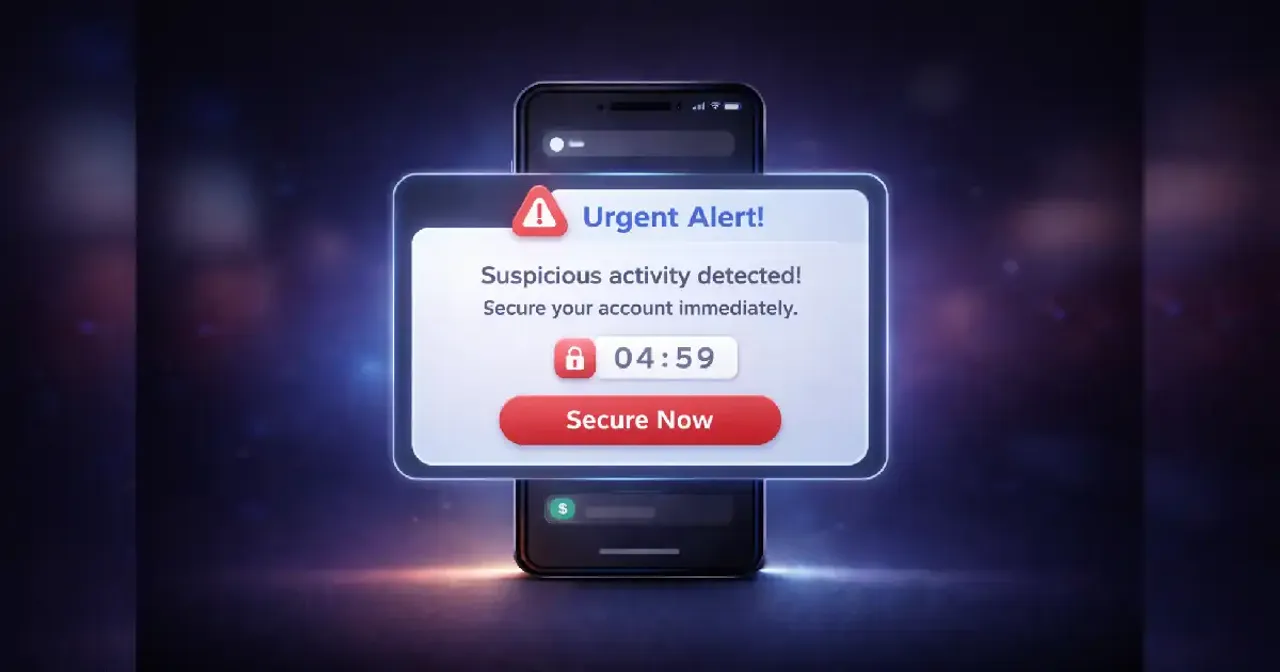
Bright colors, bold language, countdown timers, and exclamation marks all communicate importance. Even subtle cueslike a red badge indicating unread messagesactivate a sense of incompletion. The brain seeks closure. We want to clear the alert.
Designers understand this. So do marketers. And increasingly, so do bad actors.
Urgency shortens thinking time. When a notification suggests something time-sensitive, it reduces the likelihood that you’ll pause to evaluate it calmly. That compressed decision window is powerful.
When Urgency Serves a Real Purpose
Not all urgency is manipulation. Some alerts are genuinely critical.
Fraud detection messages from banks, authentication codes during login, severe weather warnings, and emergency alerts all depend on immediacy. In these cases, speed protects you.
The problem is not the existence of urgent notifications. It’s the overuse of urgency in situations that are not urgent at all.
Retail apps announce “last chance” sales that repeat every week. Streaming platforms flag “trending now” content as if it might disappear instantly. Subscription services send multiple reminders before a renewal date.
Over time, the line between necessary and manufactured urgency becomes blurred.
Manufactured Pressure in Everyday Apps
If you’ve ever opened an app to see a countdown clock attached to a discount, you’ve experienced designed urgency. The ticking timer creates a subtle sense of scarcity. Even if the offer reappears later, the immediate framing encourages faster decisions.
In 2025, behavioral design has become more refined. Platforms use data to determine when you are most likely to respond. Notifications are timed based on your activity patternslate evenings, commute hours, or lunch breaks.
This personalization increases effectiveness. The alert arrives not randomly, but when your guard may be lower or your routine more predictable.
It feels spontaneous. It is often strategic.
Urgency and Security Scares
One of the most impactful uses of urgency appears in security-related notifications.
“Unusual login attempt.”
“Account temporarily restricted.”
“Verify now to prevent suspension.”
These messages trigger concern. Even when legitimate, they create emotional acceleration. When fraudulent, they rely on panic.
Scam messages often imitate official security alerts because urgency reduces skepticism. If a notification suggests immediate consequences, people are less likely to scrutinize details.
In recent months, the quality of such imitation has improved. AI-generated text can mimic official tone, reducing obvious warning signs. Urgency combined with authenticity becomes persuasive.
The tactic works not because people are careless, but because they care.
The Cost of Constant Alerts
Beyond security risks, there is a cognitive cost to perpetual urgency.
Frequent interruptions fragment attention. Studies in recent years have shown that even brief notifications can reduce concentration long after the alert is dismissed. The mind shifts from deep focus to reactive mode.
Living in a state of constant alert reshapes habits. Quick responses become the norm. Reflection feels inefficient. Silence feels unusual.
When everything is framed as urgent, truly important signals may lose distinction.
This phenomenon is sometimes called “alert fatigue.” The more notifications we receive, the less meaning each one carries. Yet paradoxically, we continue checking them reflexively.
Why It Matters for Digital Awareness
Understanding how urgency is engineered restores perspective.
When you recognize that a countdown timer is a design choicenot a life-or-death scenariothe emotional pressure softens. When you see that repeated “limited time” offers are part of a pattern, the urgency loses intensity.
Digital literacy today includes recognizing persuasive design. It’s not about rejecting technology. It’s about seeing the mechanics behind the experience.
Urgent notifications shape purchasing decisions, influence emotional states, and sometimes expose vulnerabilities. Being aware of that influence shifts the balance slightly back to the user.
The Role of Personalization
Modern notification systems are adaptive. They track open rates, response times, and engagement patterns. If you respond quickly to certain alerts, the system learns to prioritize similar ones.
Over the past year, machine learning tools have become more effective at predicting when you are most likely to act. This doesn’t mean someone is watching you individually. It means your behavioral data trains systems to optimize timing.
The result is subtle reinforcement. Fast reactions become habitual. Slower decision-making feels countercultural.
Personalization enhances conveniencebut it also fine-tunes urgency.
Distinguishing Signal from Noise
One of the challenges of the current digital landscape is separating meaningful alerts from background noise.
A legitimate fraud warning deserves attention. A promotional push labeled “urgent” often does not.
The distinction is not always obvious. But patterns help. Does the same app send “urgent” messages weekly? Does the alert demand action within minutes without clear explanation? Does it rely on emotional language rather than specific detail?
Urgency that repeats loses credibility.
Pausingeven brieflyreintroduces clarity.
The Future of Notifications
As devices integrate more deeply into daily lifethrough wearables, smart home systems, and vehicle dashboardsnotifications will expand beyond phone screens.
In the coming years, urgency may arrive through voice assistants or subtle haptic signals. The boundary between ambient information and direct interruption may blur further.
At the same time, awareness is growing. Many users are reevaluating notification settings, prioritizing certain alerts while silencing others. Digital wellbeing tools are evolving to help manage interruption.
The balance between connection and overload is still being negotiated.
Reclaiming Attention
Attention is finite. Urgency competes for it aggressively.
Recognizing that some urgent notifications are designed to accelerate decisions gives you space to slow down. That space, even if only a few seconds, changes outcomes.
Before reacting, it helps to ask: Is this truly urgent? Or is it designed to feel that way?
The answer may vary. But the question itself restores agency.
In a world where everything seems time-sensitive, the most radical act may be choosing when to respond.
Frequently Asked Questions
What are urgent notifications?
They are alerts designed to prompt immediate attention or action, often using visual cues or language that conveys time sensitivity.
Are all urgent notifications manipulative?
No. Some alerts, such as security warnings or emergency messages, are genuinely important. Others use urgency as a persuasive design tactic.
Why do apps use countdown timers and red badges?
These design elements trigger psychological responses linked to scarcity, incompletion, and priority, encouraging faster engagement.
Can urgent notifications affect decision-making?
Yes. Urgency shortens reflection time and can increase impulsive actions, especially when combined with emotional language.
Will notification design become more personalized?
Yes. Modern systems already use behavioral data to optimize timing and content, and this trend is likely to continue.