
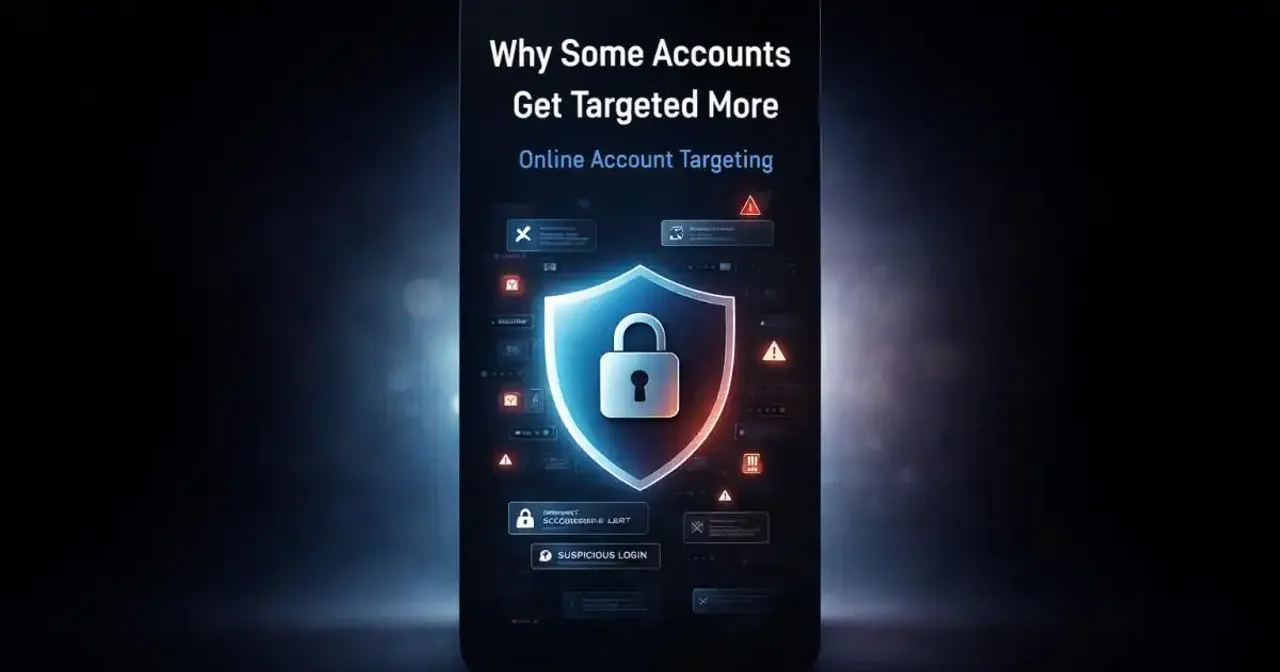
Online account targeting isn’t random, even if it feels that way when a login alert flashes across your screen. Some profiles attract far more attention than others, and not always for obvious reasons. Over the past few years especially as digital life has deepened in 2024 and 2025the patterns behind who gets targeted and why have become clearer. What looks like bad luck is often a mix of visibility, behavior, data exposure, and timing.
The internet doesn’t treat all accounts equally. It responds to signals. And those signals quietly shape who becomes a target.
Visibility Is the First Multiplier
The more visible an account is, the more likely it is to draw attention. That doesn’t necessarily mean fame. It can be as simple as running a small online business, being active in public comment sections, or sharing frequent updates on social platforms.
Public-facing profiles are easier to discover, easier to analyze, and easier to test. Attackers, whether automated bots or individuals, often begin with what is already out in the open. A username reused across multiple platforms. An email address listed on a website. A contact form that reveals a pattern.
In recent years, as personal branding has become commoneven for freelancers, students, and creatorsexposure has expanded. A single account may now connect to professional profiles, payment tools, and communication apps. Visibility doesn’t guarantee targeting, but it increases the surface area.
Accounts that are easier to find are easier to probe.
Patterns in Behavior Create Predictability
Online account targeting often hinges less on who someone is and more on how they behave.
People tend to follow habits. Logging in at the same time daily. Posting during predictable hours. Reusing similar passwords with small variations. Clicking links from certain types of messages. These patterns make behavior easier to anticipate.
Automation has amplified this. Bots can monitor activity rhythms and test credentials quietly over time. They don’t need personal grudges or insider knowledge. They rely on probability.
In the last year especially, reports from cybersecurity researchers have highlighted how credential-stuffing attacks exploit repetition. If one data breach exposes login details for a shopping site, automated systems may attempt the same combination elsewhere. Accounts with repeated credentials are disproportionately affectednot because they’re important, but because they fit a predictable pattern.
Predictability is efficient fuel for targeting.
Data Exposure Beyond Your Control
One uncomfortable truth is that people can become targets even when they have done little wrong. Data breaches, third-party leaks, and platform vulnerabilities create ripple effects.
An email address shared with a retailer five years ago may surface in a breach database today. That information can circulate quietly through underground forums or automated scanning systems. From there, it becomes a starting point.
This is one reason why online account targeting sometimes feels arbitrary. It may have little to do with recent behavior. Instead, it can trace back to older digital footprints resurfacing in new contexts.
Over time, the accumulation of small exposuresnewsletter signups, app registrations, loyalty programsforms a detailed mosaic. No single piece seems risky. Together, they build a searchable identity.
The more places your data lives, the more potential entry points exist.
Financial Signals Attract Attention
Accounts connected to financial activity often see increased targeting. That includes not just banking profiles but digital wallets, subscription services, and marketplace seller accounts.
Why? Because attackers calculate value. An account linked to payment systems represents a direct path to financial gain. Even small balances across many accounts can add up when scaled.
In 2025, as digital payments have become routine worldwide, the number of financial touchpoints in a single person’s digital life has multiplied. A food delivery app. A ride-share service. A cloud storage subscription. Each account stores some form of payment detail.
Not every account with payment information is targeted equally. Those that appear active, transactional, or tied to business operations may be tested more frequently. Activity signals potential liquidity.
It’s less about wealth and more about movement.
Public Controversy and Attention Spikes
There’s another layer that often goes unnoticed: moments of heightened visibility.
People who experience sudden attentionwhether through viral posts, professional announcements, or public disagreementssometimes see increased account probing. The spike in interest doesn’t always come from malicious intent, but attention amplifies exposure.
When a profile suddenly appears in search results more often, when a username trends, when media mentions circulate, it becomes easier for automated systems to detect and catalog.
Even minor influencers, community organizers, or business owners can experience this. Attention creates digital footprints that expand quickly.
Online account targeting sometimes follows attention waves.
Perceived Authority or Influence
Accounts that hold administrative rolesmoderators, page managers, team leads, or business operatorsare particularly attractive targets.
This isn’t personal. It’s strategic.
Administrative accounts often grant access beyond individual profiles. A compromised moderator account can affect entire communities. A business login can expose customer data. An email tied to domain ownership can impact web presence.
Attackers look for leverage points. Authority, even on a small scale, increases leverage.
In recent months, cybersecurity analysts have pointed out how phishing campaigns increasingly impersonate internal communications, targeting people in positions that control access rather than the average user. The objective is efficiency: one account that opens many doors.
Demographics and Social Engineering
Not all targeting relies on technical vulnerability. Some of it is psychological.
Certain groups are approached differently. Younger users may receive messages designed to look like collaboration offers or giveaways. Professionals might see messages framed as job opportunities or invoice disputes. Parents might encounter school-related scams.
Social engineering thrives on relatability. The more a message reflects someone’s lifestyle or current concerns, the more persuasive it becomes.
That’s why online account targeting often adapts to trends. During tax season, financial impersonation attempts increase. Around major shopping periods, fake order confirmations multiply. When new platforms surge in popularity, imitation login pages follow.
The targeting mirrors real life.
The Role of Automation
Behind much of this is automation. Most account probing isn’t a person manually typing your name into a search bar. It’s software scanning enormous volumes of data.
Automated scripts test common passwords across millions of email addresses. Bots scrape publicly available information to build databases. Algorithms sort accounts by likelihood of success.
Automation shifts targeting from personal to statistical.
In the past decade, and increasingly through 2024 and 2025, these systems have grown more efficient. They don’t need to “know” you. They calculate odds.
Accounts that match common combinationspopular email domains, simple passwords, reused usernamesrise to the top of probability lists. It’s not about importance. It’s about efficiency.
Why This Matters to Ordinary Users
It’s easy to assume that targeting happens to celebrities, corporations, or high-profile figures. But most incidents affect ordinary individuals.
The reason this matters isn’t only financial loss. It’s the ripple effect. A compromised social media account can damage professional relationships. A hijacked email can disrupt personal communication. A frozen subscription account can block access to stored memories, documents, or creative work.
In a world where identity and daily function are intertwined with digital platforms, account access is stability.
Understanding why some accounts get targeted more than others helps reframe the experience. It moves the narrative away from paranoia and toward awareness. Targeting isn’t always personal. Often, it’s structural.
And structural risks can be understood.
The Future Direction of Online Targeting
Looking ahead, patterns suggest targeting will become more contextual rather than purely technical.
As artificial intelligence systems improve, impersonation messages are becoming more convincing. Language feels natural. Timing aligns with real-world events. Messages reference details that seem specific.
At the same time, platforms are investing in stronger authentication layers and anomaly detection. Suspicious login patterns trigger alerts more quickly. Biometric verification is expanding. Behavioral analysis tools monitor unusual account activity.
The landscape is dynamic. Targeting methods evolve, but so do defenses.
One emerging shift is the growing importance of digital literacy. Awareness of how data circulates, how automation works, and how behavioral patterns can be read is becoming part of everyday digital competence.
The more people understand the mechanics, the less mysterious targeting feels.
A Digital Ecosystem, Not a Lottery
It helps to think of the internet less as a random space and more as an ecosystem. Accounts exist within networks of data, visibility, and behavior.
Some are more exposed because they’re public-facing. Some are more predictable because habits repeat. Some are connected to financial systems. Some sit in administrative roles. Some become visible during moments of attention.
Online account targeting reflects these variables. It’s rarely about personal worth. It’s about probability, exposure, and opportunity.
When viewed through that lens, the experience becomes less about “Why me?” and more about understanding the broader digital environment we all inhabit.
The internet doesn’t single people out for who they are. It scans for patterns. And patterns, once recognized, can be managed.
Frequently Asked Questions
Why do hackers target some online accounts more than others?
Most targeting is automated and based on probability. Accounts that are highly visible, reused across platforms, connected to financial systems, or associated with administrative roles often rank higher in automated scans.
Does having a small social media following reduce the risk of online account targeting?
Not necessarily. Even low-profile accounts can be targeted if their credentials appear in data breaches or match common password patterns. Targeting is often statistical rather than fame-driven.
Can old data breaches still affect me years later?
Yes. Information exposed in past breaches can circulate for years and be reused in automated credential testing. Older leaks remain relevant because many people reuse login details.
Are business accounts more likely to be targeted than personal ones?
Accounts tied to payments, customers, or administrative control tend to attract more probing because they offer greater potential access or financial return.
Is online account targeting increasing in 2025?
Digital targeting methods continue to evolve alongside automation and AI tools. While platforms are improving defenses, the overall volume of automated scanning and phishing attempts remains high due to the scale of online activity.